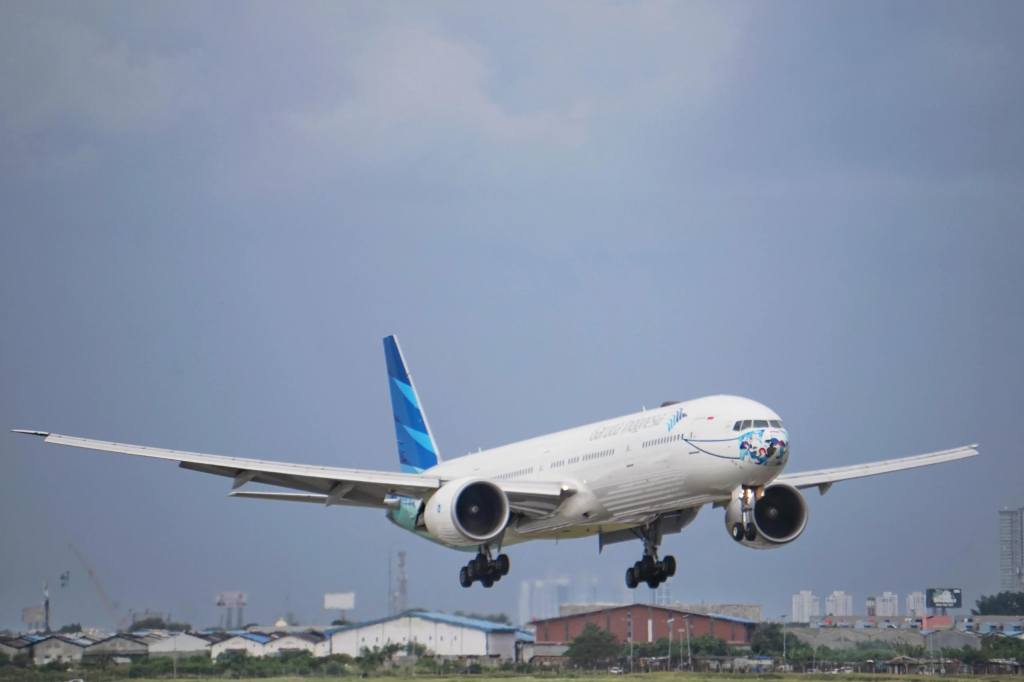
Jakarta, Indonesia – October 22, 2025: Garuda Indonesia Boeing 777-300ER passenger aircraft approaching Soekarno-Hatta International Airport (CGK) in Tangerang, Indonesia.
Indonesia’s aviation network is beginning to recover after volcanic ash from Mount Anak Krakatau disrupted almost 3,000 flights and affected approximately 341,000 passengers, exposing the vulnerability of the country’s highly interconnected tourism and air transport network.
Jakarta’s Soekarno-Hatta International Airport and Halim Perdanakusuma Airport, along with several regional airports, resumed operations on Tuesday, September 8, after authorities determined that conditions had become safe for aviation.
But the reopening does not yet mean a return to normal.
Anak Krakatau remained active and erupted again on Tuesday, reported Reuters, prompting authorities to continue monitoring the volcano, volcanic ash and wind conditions. Reuters reported that the fresh eruptions raised the possibility of further disruption depending on the height of the ash plume and its direction.
For Indonesia’s travel industry, the episode offers a vivid example of how quickly a natural event can ripple through international aviation — affecting airlines, airports, hotels, tour operators and travellers far beyond the immediate area of the eruption.
Nearly 3,000 flights affected
According to Indonesia’s Transportation Ministry, 2,961 domestic and international flights were affected by cancellations, delays and diversions, including 2,339 domestic flights and 622 international services. Approximately 341,000 passengers were affected.
The figures were reported by Indonesia’s national news agency ANTARA, citing Transportation Minister Dudy Purwagandhi.
The disruption followed the eruption of Anak Krakatau in the Sunda Strait between Java and Sumatra. Volcanic ash spread across parts of western Indonesia, prompting authorities to close a number of airports as a precaution.
The scale of the disruption grew rapidly. An earlier Reuters report said more than 1,500 flights and 170,000 passengers had already been affected on September 6, before the total rose to almost 3,000 flights and 341,000 passengers.
Why volcanic ash is a serious aviation risk
Volcanic ash presents a particular challenge for aviation because fine particles can enter aircraft engines and other critical systems.
Authorities therefore cannot treat an airport reopening simply as a matter of clearing a runway. Aircraft need to be inspected, airport infrastructure checked and airspace assessed before normal operations can resume.
The Associated Press reported that airport authorities and airlines were required to inspect aircraft before flights resumed, while pilots and flight crews were instructed to remain aware of restricted airspace around areas affected by volcanic ash.
Indonesia also took a cautious approach to reopening.
ANTARA reported that authorities were monitoring advisories from the Volcanic Ash Advisory Center in Darwin, while airport ground crews inspected and cleared runways, taxiways and aprons and airlines checked aircraft for volcanic ash contamination.
178 aircraft add to the recovery challenge
The disruption also created a significant operational problem for airlines.
Reuters reported that 178 aircraft were grounded at Soekarno-Hatta during the closure and that authorities would check their airworthiness before they returned to service. This illustrates why the impact of an airport closure can continue even after the airport itself reopens.
Airlines must not only restart cancelled flights. They also need to reposition aircraft and crews, rebook passengers, manage aircraft inspections and work through accumulated delays.
The result can be a domino effect across an airline’s wider network.
The financial implications are also significant. Reuters reported that the disruption could cost airlines as much as 19 billion rupiah, or around US$1 million, per day.
The disruption reaches beyond Jakarta
The impact has also demonstrated how dependent Indonesia’s tourism economy is on reliable air connectivity. A traveller may not be visiting Jakarta at all but can still be affected if their itinerary requires a connection through the capital.
International services feed into Indonesia’s extensive domestic aviation network, connecting major gateways with tourism destinations across the archipelago. When a major hub is disrupted, the effects can therefore travel much further than the original event.
Passengers were also affected in Bali as flights between the island and Jakarta were cancelled. Reuters reported on stranded passengers at Bali’s Ngurah Rai International Airport during the disruption.
For hotels, tour operators and destination management companies, this creates a second layer of disruption.
A cancelled flight can mean a guest who does not arrive, a hotel booking that needs to be changed, a missed tour or an itinerary that needs to be reorganised.