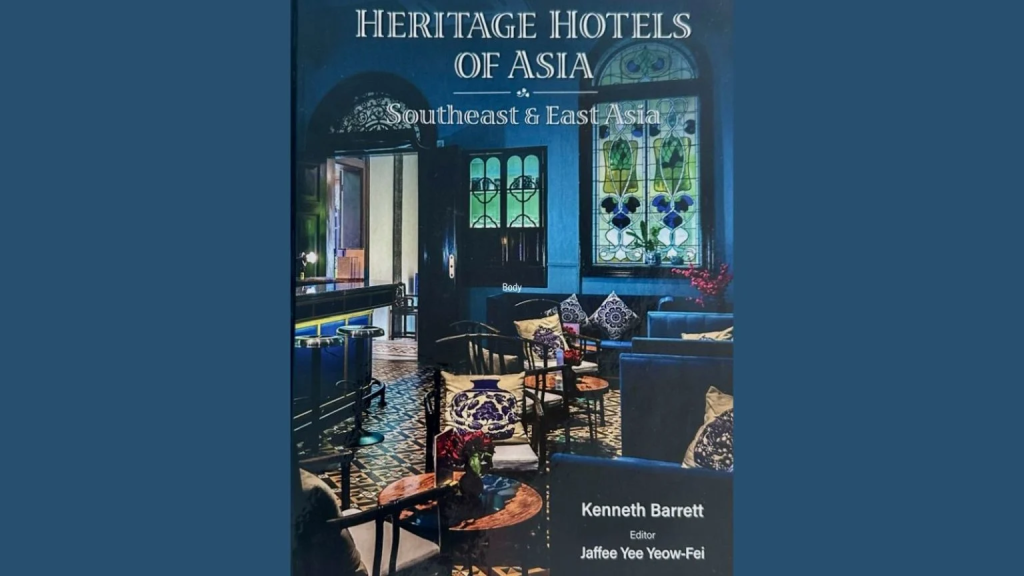
Heritage Hotels of Asia: Southeast & East Asia explores 56 historic properties across 13 countries, documenting the architecture, people and stories behind Asia’s most iconic heritage hotels.
Heritage Hotels of Asia: Southeast & East Asia, the second volume in this two-part series, follows the expansion of European trade and travel beyond India. The opening of the Suez Canal, advances in steamship travel and expanding railway networks ushered in the golden age of the grand hotel. More than places to stay, these magnificent properties became centres of colonial society and remain treasured cultural landmarks today. Together, the two volumes explore their architecture, history and the remarkable people behind them, celebrating the enduring romance of travel across Asia.
Introduction: Grand Hotels as Living History
The finest heritage hotels are not simply elegant buildings or luxurious places in which to stay. They are witnesses to a changing world, shaped by the people, politics, commerce and great journeys of their time. This fascinating connection lies at the heart of Heritage Hotels of Asia, an impressive two-volume work by distinguished writer Kenneth Barrett, edited by Jaffee Yee Yeow-Fei.
When I first picked up Heritage Hotels of Asia, I felt an immediate sense of excitement. Here was an invitation to step inside some of the region’s most magnificent hotels and discover how profoundly they have shaped the character, atmosphere and sense of place of their destinations.
Meticulously researched, these volumes contain an encyclopaedic wealth of historical detail. They are surely destined to become important reference works for anyone interested in Asian history and the development of travel and tourism throughout the region.
AsiaPacific travel
Yet this is far more than a scholarly record. Through Kenneth Barrett’s accessible and immersive writing, complemented by a rich collection of illustrations, readers are given the feeling of crossing each hotel’s threshold for themselves. The history, grandeur and distinctive personality of every property gradually unfold, bringing its stories vividly to life.
Grand hotels and history are inseparable. These remarkable properties are far more than elegant places to stay. Each reflects the rich tapestry of the country, region or city in which it stands. Through architecture, art, tradition and carefully preserved historical references, they connect travellers with their surroundings while immersing them in the atmosphere of another era.
At the same time, they offer a haven of luxury, gracious hospitality and elegant service. This compelling combination of history, culture and refinement is what makes the great heritage hotels of Asia so captivating.
The Author and His Expertise
Ken Barrett is a skilled and highly experienced writer who has contributed to many of Thailand’s leading publications. He is also a published author. His meticulous research, extensive knowledge of Asia and natural ability as a storyteller are evident throughout this beautifully produced work.
The Birth of the Modern Hotel

The opening pages establish that the history of the modern hotel is also the history of modern travel. Hotels developed as improvements in stagecoach design made long-distance journeys more tolerable. The arrival of steam trains and expanding railway networks brought travel to a wider public. Across Asia, hotels followed the great trade routes, accommodating administrators, merchants, scholars, tourists and adventurers.

The book traces the origins of Asia’s modern hotels to Spence’s Hotel in Calcutta, opened in 1830. The opening of the Suez Canal in 1869 and advances in steamship travel subsequently accelerated the movement of travellers eastwards and helped create the beginnings of luxury tourism.
Hotels gradually became far more than convenient places to sleep and eat. By the closing years of the nineteenth century and the beginning of the twentieth, the era of the grand hotel had arrived. These magnificent establishments became centres of colonial society, commerce, diplomacy and entertainment. Their dining rooms, ballrooms, bars and verandahs served as meeting places where deals were negotiated, news exchanged and reputations made.
An Extraordinary Journey Through Asia
One of the book’s strongest selling points is its extraordinary scope. Volume Two presents the histories of 56 remarkable properties across 13 countries and territories, taking the reader on a grand journey through Southeast and East Asia.
Asians& Diaspora

Raffles Hotel in Singapore which was renovated during the period 1989-1991 using 1915 as the benchmark year
Among the celebrated hotels featured are The Strand in Yangon; Malaysia’s Eastern & Oriental Hotel, Cheong Fatt Tze Mansion and Hotel Majestic; and Singapore’s legendary Raffles, together with the Goodwood Park Hotel, Fullerton Hotel and Capella.
Indonesia is represented by such historic names as Hotel Majapahit, Phoenix Hotel, Hotel Savoy Homann and Hotel Indonesia Kempinski, while the Philippines includes The Manila Hotel and Rizal Park Hotel.
Thailand’s heritage collection embraces the Mandarin Oriental Bangkok, Chakrabongse Villas, 137 Pillars House in Chiang Mai and the Centara Grand Beach Resort in Hua Hin.
City& Local Guides
The journey through former French Indochina includes Vietnam’s Sofitel Legend Metropole Hanoi, Hotel Continental, Hotel Majestic and Dalat Palace Hotel; Cambodia’s Raffles Hotel Le Royal, Raffles Grand Hotel d’Angkor and Bokor Palace; and Laos’s Settha Palace Hotel.
Moving further east, the book features Hong Kong’s iconic The Peninsula and Tai O Heritage Hotel; China’s Fairmont Peace Hotel, Waldorf Astoria Shanghai, Beijing Hoteland Astor Hotel; Taiwan’s celebrated Grand Hotel; and Japan’s Nikko Kanaya Hotel, Fujiya Hotel and Tokyo Station Hotel.
This impressive geographical sweep gives the book much of its strength. Some of the properties were purpose-built as grand hotels, while others began life as mansions, government buildings, warehouses, railway hotels or private residences before being carefully conserved and transformed. What unites them is a compelling historical narrative and a genuine connection to the culture and character of their cities.
A Book to Read, Treasure and Revisit

Beautifully presented and richly illustrated with historic photographs, postcards, posters and luggage labels, this is both a pleasure to read and a book to treasure. It would make a perfect birthday or Christmas gift, but it is considerably more than an attractive coffee-table book.

It is destined to become an invaluable reference for hoteliers, architects, designers, tourism professionals, hospitality students and everyone who appreciates the history, character and romance of travel.
Tourismindustry news
Ken Barrett has achieved something very special. He has not merely documented historic buildings; he has brought to life the people, journeys and events that unfolded within them. These hotels are living chapters in the history of Asia, and this magnificent book ensures that their stories will continue to be told.
The books are published by World Scientific Publishing Singapore and are available in Kinokuniya Bangkok and all major bookstores in the region or purchased online directly from the publisher.
HERITAGE HOTELS OF ASIA
Volume 2: Southeast & East Asia
Copyright © 2026 by Kenneth Barrett and Jaffee Yee Yeow-Fei
All rights reserved.
ISBN 978-981-98-2491-5 (hardcover)
ISBN 978-981-98-2492-2 (ebook for institutions)
ISBN 978-981-98-2493-9 (ebook for individuals)