Galay Gyeltshen discusses Bhutan’s rapid tourism growth, Gelephu Mindfulness City, mindful travel and climate resilience as the country develops while retaining its high-value, low-volume philosophy.
Bhutan is entering a period of significant tourism growth while attempting to preserve the principles that have made its development model distinctive. At the centre of this next chapter is an ambitious project that could fundamentally reshape how international visitors enter and experience the country: Gelephu Mindfulness City.
In this episode of Travel Dialogues South Asia, Prof. Dr Wolfgang Georg Arlt speaks with Galay Gyeltshen, founder of Mindful Path Tours, about Bhutan tourism and Gelephu Mindfulness City, the country’s continued “high value, low volume” philosophy and the growing importance of climate resilience in tourism planning.
Gyeltshen brings both tourism and development perspectives to the conversation. He founded inbound DMC Mindful Path Tours in 2025 and is also involved in developing tourism and business services for the Gelephu Mindfulness City project.
Meaningful and slow travel rather than volume
Mindful Path Tours itself reflects the direction Gyeltshen sees for Bhutanese tourism.
The company specialises in meaningful, slow and transformative journeys built around four pillars: spiritual and mindful travel, nature and adventure, wellness, and leisure and MICE.
These products fit naturally within Bhutan’s broader approach to tourism, which has historically prioritised value and controlled development rather than pursuing visitor numbers alone.
Yet visitor numbers are now rising quickly.
Bhutan welcomed approximately 209,000 visitors in 2025, an increase of 44% year-on-year. During the first half of 2026, arrivals reached around 149,000, up 48% year-on-year.
Tourism is also an important contributor to the national economy. According to the discussion, it is Bhutan’s second-largest earner after hydropower and contributes approximately 10–15% of GDP.
Tourismindustry reports
The challenge, therefore, is how to accommodate growth without allowing growth itself to become the objective.
Hotels and skills are developing alongside demand
The expansion is already generating investment in tourism infrastructure.
New hotels are opening, while workforce development is addressing another fundamental requirement: ensuring Bhutanese professionals have the skills necessary to serve an increasingly international visitor base.
The Desung Skilling Program provides young Bhutanese with training in areas including guiding and culinary arts. Foreign-language training covers Mandarin, Spanish, German, Japanese and Korean.
Access to the country nevertheless remains deliberately structured.
International visitors must book through a registered tour operator or DMC. The Sustainable Development Fee (SDF) for international guests has been temporarily reduced from US$200 to US$100 per person per night, while regional visitors from India and Bangladesh pay ₹1,200 per night.
This system remains central to Bhutan’s attempt to balance tourism’s economic benefits with the need to manage its impact.
Growth is already significant relative to Bhutan’s population
Visitor numbers also need to be considered in relation to the country’s size.
Bhutan has a population of approximately 800,000. With 209,000 visitors in 2025, the ratio equates to roughly 25 visitors for every 100 inhabitants, compared with a global average of 18 cited in the discussion.
That puts the debate around “high value, low volume” into a different perspective.
Bhutan may receive relatively modest absolute visitor numbers compared with major Asian tourism destinations, but tourism already represents a significant presence relative to its population.
Future development therefore requires more than simply increasing arrivals. Infrastructure, local economic participation, environmental protection and community capacity all become increasingly important as tourism expands.
Gelephu Mindfulness City: A different kind of development
The most ambitious element of Bhutan’s future tourism landscape is Gelephu Mindfulness City (GMC).
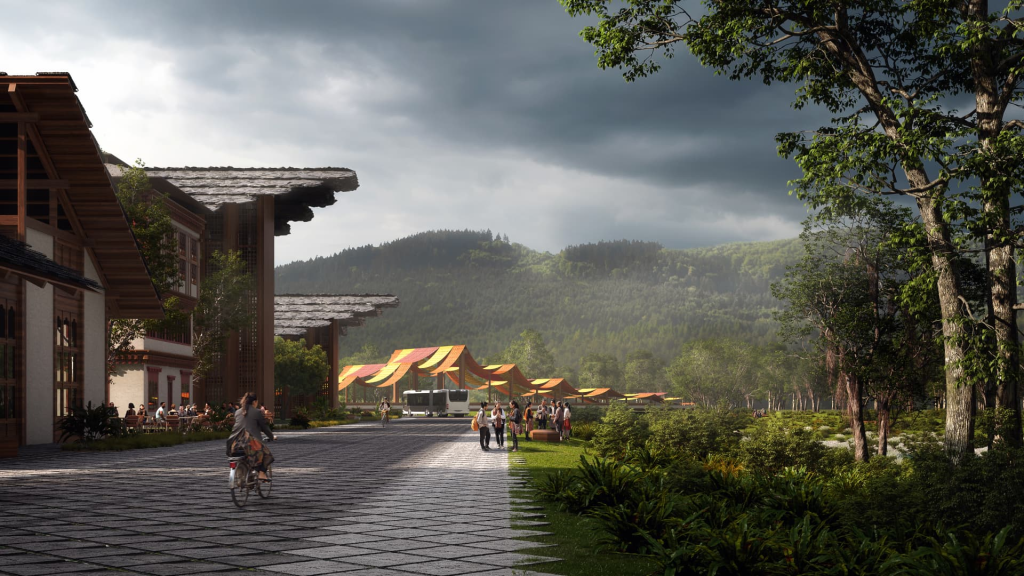
The project, envisioned by Bhutan’s fifth King, aims to create a new type of urban development integrating Buddhist spiritual values, nature, modern technology and business.
Located in Sarpang in southern Bhutan near the Indian border, GMC is planned across more than 2,500 square kilometres. According to the discussion, this makes the planned area larger than Singapore and equivalent to roughly 10% of Bhutan’s territory.
The scale is extraordinary, but the philosophy behind the project is arguably more significant.
Rather than separating urban development from the surrounding environment, the concept seeks to integrate the two.
Buildings below the trees and no fossil-fuel vehicles
Gelephu Mindfulness City was announced in December 2023 and officially chartered in February 2024, with international planners BIG involved in its design.
Environmental principles are embedded directly into the plans.
Buildings will not be allowed to exceed the height of trees, while the city is intended to operate without fossil-fuel vehicles.
Planning also incorporates biological corridors that allow wildlife, including elephants, to move through the landscape, alongside mindful management of rivers and the wider natural environment.
For tourism, this creates an interesting proposition.
Rather than adding tourism infrastructure to an existing urban environment, Bhutan has an opportunity to consider visitor experiences, mobility, wellness and environmental management as part of the development from the beginning.
A second international gateway to Bhutan
Connectivity will be fundamental to whether this vision translates into tourism demand.
Site preparation is underway for an international airport at Gelephu, with more than 7,000 volunteers involved. Completion is expected by the end of 2029.
The airport is intended to provide Bhutan with a second major international gateway.
Its significance could be substantial.
Bhutan’s geography and limited gateways have historically influenced the scale and structure of its tourism sector. A second major entry point in the south could change visitor flows and create new itinerary possibilities.
The longer-term outlook presented in the discussion suggests that completion of Gelephu International Airport could potentially double Bhutan’s visitor capacity.
Forty tourism products built around transformation
The tourism proposition planned for GMC also reflects Bhutan’s broader positioning.
A 40-product pipeline is being developed, comprising 20 attractions and 20 activities with an emphasis on transformative experiences. The city itself is envisioned as a “dharma center.”
Spirituality and wellness will form a substantial part of this proposition.
Twenty-two Buddhist masters and spiritual practitioners have been approved to establish meditation centres, wellness retreats and yoga facilities.
The first completed structure within GMC is the Chhogo Center. Community participation is also significant, with a major initiative involving more than 40,000 registered volunteers, including over 1,000 international participants, to construct 108 large stupas.
This gives Bhutan tourism and Gelephu Mindfulness City a potentially distinctive position within the rapidly expanding global wellness sector.
The proposition is not simply wellness infrastructure. It connects wellness with Buddhist traditions, nature and Bhutan’s existing destination identity.
Climate change is already part of tourism planning
But the conversation between Arlt and Gyeltshen also addresses a much more immediate challenge.
Bhutan’s natural environment is central to its tourism proposition, yet that same environment is increasingly exposed to climate-related risks.
Glacial Lake Outburst Floods (GLOFs) represent a significant threat as Himalayan glaciers melt. Of more than 2,500 glacial lakes, over 65 are classified as high-risk.
Research cited in the discussion indicates potential exposure for more than 400 bridges and approximately 11,000 people, particularly in the Punakha and Wangdi valleys.
For tourism businesses, climate adaptation therefore cannot remain an abstract sustainability discussion. It increasingly becomes an operational issue.
Early warning systems, safer routes and trained guides
Bhutan is already responding through several measures.
Early-warning systems have been introduced in high-risk valleys, while work is underway to reduce the level of dangerous glacial lakes safely. Thoarthurmi Lake in Lunana is cited as one example.
Tourism planning is also adapting.
Climate-smart approaches are being applied to routes, hotels and infrastructure located close to rivers. Operators are considering more flexible itineraries, while guides receive training in emergency response.
Mock flood drills have taken place in Punakha, while earthquake drills have been conducted in Thimphu.
These measures suggest that climate resilience will increasingly become part of destination management rather than a separate environmental policy.
Communication after a disaster matters too
One particularly relevant point for the tourism industry concerns communication.
A localised natural disaster can quickly create an international perception that an entire country is unsafe.
The discussion therefore highlights the need for clear post-disaster communication that explains where an incident has occurred and distinguishes affected areas from parts of the destination that continue operating normally.
For destinations dependent on international tourism, this is increasingly important.
Climate resilience is not only about protecting infrastructure and people. It also requires the ability to communicate accurate information quickly enough to prevent a local event from unnecessarily damaging confidence in the wider destination.
Can Bhutan grow without abandoning “high value, low volume”?
The next five to ten years could fundamentally change Bhutanese tourism.
Demand for meaningful, slow and sustainable travel is expected to support continued growth. Gelephu and its international airport could provide a second major gateway, while wellness and mindfulness could become increasingly important components of the country’s international positioning.
There is also an expectation that rules could become tighter to ensure a greater proportion of tourism revenue remains with local operators and communities.
At the same time, climate-smart practices — from early-warning systems and safer routes to disaster-aware itinerary design — are expected to become standard elements of tourism operations.
Yet perhaps the most important point is what Bhutan does not intend to change.
Even as visitor numbers increase, the country’s “high value, low volume” philosophy is expected to remain, with quality prioritised over quantity. The ambition is for Bhutan to become a global example of responsible tourism that benefits its land, culture and people.
That creates an unusual tourism development test.
Bhutan is not asking simply how many more visitors it can accommodate.
It is attempting to answer a more difficult question: how can a destination grow while protecting the qualities that made people want to visit in the first place?
Gelephu Mindfulness City, climate-smart tourism planning and the continued emphasis on meaningful experiences suggest that Bhutan intends to find its own answer.