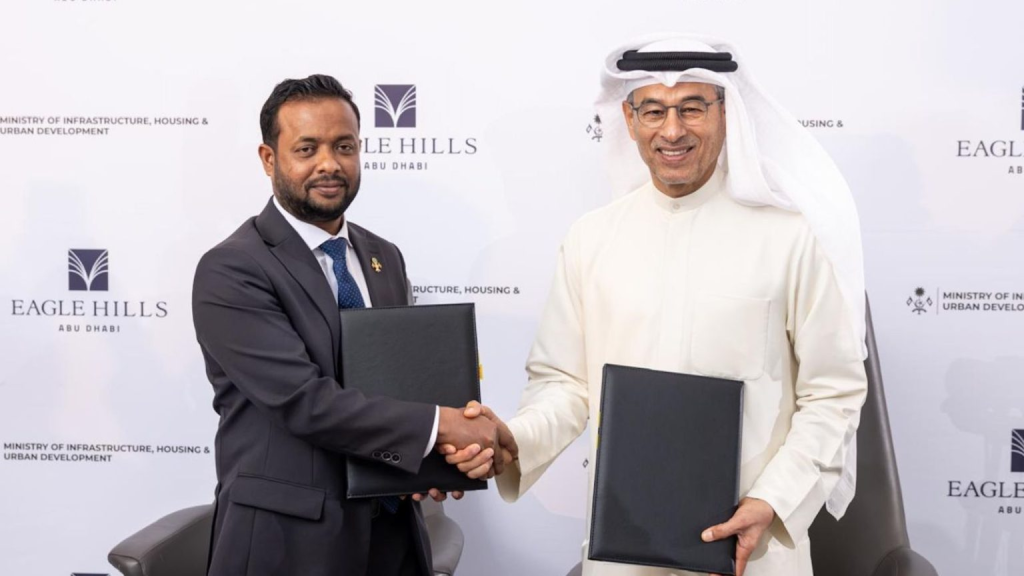
Eagle Hills and the Maldives government have agreed commercial terms for a major Ras Malé development combining hotels, residences, a marina, retail and community infrastructure.
Eagle Hills and the Government of Maldives have signed a commercial terms agreement for the proposed Maldives Waterfront Marina development in Ras Malé. The agreement sets out the shared vision and principal commercial terms for the project. However, the parties will develop more detailed terms as the project moves forward.
The planned integrated destination will combine tourism, residential, commercial and community uses. Hotels and resorts will sit alongside premium and branded residences, a marina, waterfront leisure, retail and dining. In addition, the masterplan includes entertainment, wellness, education, healthcare and community facilities.
Ras Malé project targets a broader tourism offer
The partners intend the development to expand the Maldives’ traditional resort-led tourism offer. In particular, the project will introduce a larger mix of marina, waterfront and residential experiences. It also aims to attract additional international visitor segments and encourage longer and repeat stays.
Mohamed Alabbar, Chairman of Eagle Hills, said:
“The Maldives is a truly special place, with unmatched beauty and global appeal. Our ambition is to build responsibly on that strength and create something truly world-class.”
The project will bring hotels, residences and leisure uses together around the waterfront. Public spaces and community infrastructure will also form part of the destination. As a result, the development aims to support both tourism activity and year-round residential and commercial use.
Hotelmanagement software
H.E. Dr. Abdulla Muththalib, Minister of Infrastructure, Housing and Urban Development, Maldives, said:
“In Eagle Hills and its Chairman, Mr. Mohamed Alabbar, the Maldives has a partner whose record speaks for itself — from the making of Downtown Dubai to Belgrade Waterfront and destinations across three continents, few names in global real estate carry the same authority in building city-scale destinations from the ground up. That is the calibre of partnership we have secured for Ras Malé.”
Long-term leasehold model planned
Properties within Maldives Waterfront Marina will operate under a long-term leasehold framework governed by Maldivian law. Lease terms will run for up to 99 years. Moreover, the source states that each transfer, including a sale or inheritance, will start a new leasehold term of up to 99 years.
The residential component will include both premium and branded residences. Meanwhile, the marina and waterfront promenades will form a central part of the wider destination. Dining, retail, wellness and entertainment venues will support the mixed-use offer.
Environmental monitoring to accompany development
Eagle Hills says environmental considerations will guide planning and delivery. The masterplan will address the Maldives’ sensitive island and marine environment through sustainability measures and resilient infrastructure. According to the developer, the project will use reclaimed land and Eagle Hills will undertake no further dredging.
Independent marine monitoring will also accompany construction as work progresses. This process is intended to track the development’s impact on surrounding waters and the natural environment. In addition, the project plans to integrate environmental protection into its infrastructure and landscape design.
Government highlights investment and employment potential
The Maldives government expects the development to attract substantial foreign capital and stimulate activity across several sectors. These include hospitality, construction, retail, marine services and technology. It also expects the project to create direct and indirect employment over its lifetime.
“For the Maldives, this is the largest investment programme in our history — billions of dollars of foreign investment moving through our banking system, creating jobs, homes for Maldivian families, and direct revenue to the State from every sale, achieved without tax giveaways and without government borrowing.”
The government also expects the development to strengthen local supply chains and generate demand for Maldivian businesses, suppliers and professional services. Consequently, it sees the project as a way to retain more economic value within the country. The wider activity is also expected to generate tax revenue.
Beyond tourism, the authorities want the project to support a more structured real estate sector. The concept therefore combines hospitality investment with residential ownership and long-term commercial activity.
Asia-Pacifictourism trends
“Most importantly, this project establishes a structured, world-class real estate sector for the Maldives — a new pillar of our economy standing alongside tourism. It is a decisive step on our path to becoming a high-income country by 2040.”
The Maldives Waterfront Marina agreement represents an early commercial step rather than a final project contract. Further details on the development terms, delivery programme and implementation will emerge as the parties advance the project.