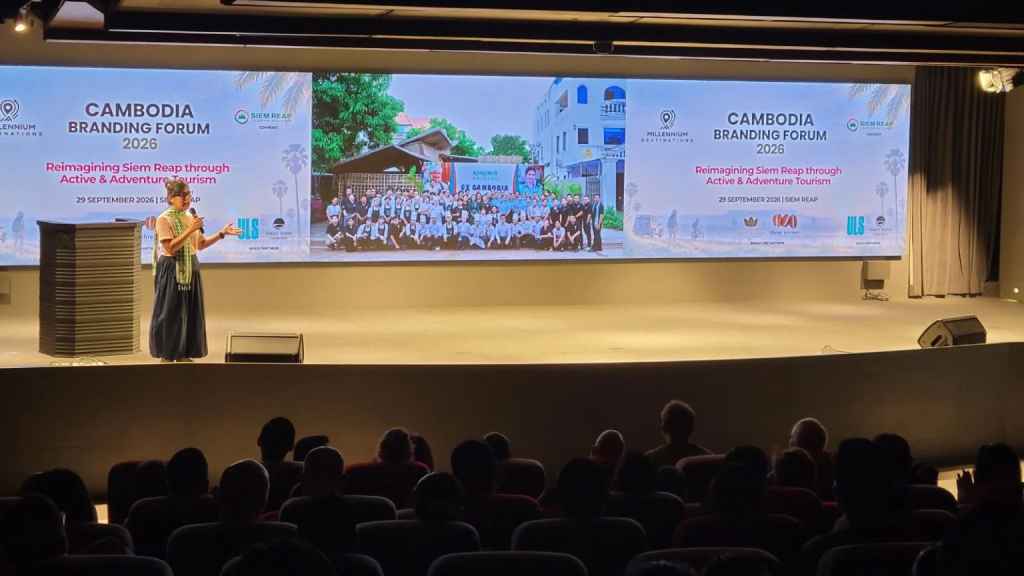
Cambodia Branding Forum 2026 brought together 131 registered stakeholders to explore how adventure tourism, community engagement and destination branding can diversify Siem Reap’s visitor economy beyond Angkor.
The Cambodia Branding Forum (CBF) 2026 brought together more than 130 participants in Siem Reap to explore how active and adventure tourism can diversify the destination beyond its world-famous Angkor temples. Held on 29 September at Commune at Rose Apple Square, the event focused on strengthening Siem Reap tourism through new visitor experiences, community participation, destination branding and practical partnerships.
- The Forum attracted 131 registrants from tourism, hospitality, creative industries, community organisations, education, conservation and sports.
- Three workshops explored tourism product development, local talent and placemaking, generating potential pilot experiences and two placemaking proposals.
- The initiative comes as Angkor recorded a 27.61% decline in international visitors during the first nine months of 2026, highlighting the importance of destination diversification.
Tourism stakeholders explore Siem Reap beyond Angkor
Organised by Millennium Destinations and co-hosted by the Siem Reap Tourism Alliance (STA), the Forum brought together representatives from across the destination’s tourism ecosystem.
Participants included hotel managers, tour operators, entrepreneurs, community representatives, artists, educators, conservation specialists, development partners and sports and wellness practitioners.
The programme connected destination branding, sustainability and tourism development through expert contributions, an eight-speaker panel and three interactive workshops. Rather than focusing exclusively on destination promotion, the discussions examined how Siem Reap can develop marketable experiences based on its existing cultural, environmental and community assets.
While Angkor remains central to the destination’s international identity, participants identified opportunities involving cycling, hiking, rural exploration, waterways, food, spirituality, wellness and contemporary creativity.
Consequently, the Forum positioned active and adventure tourism as a potential means of attracting new visitor segments, encouraging longer stays and distributing expenditure more widely across local businesses.
Collaborative destination branding moves from vision to action
The Cambodia Branding Forum was established by Millennium Destinations in 2024 as a platform connecting place branding, tourism development and community participation. Its inaugural Francophonie edition took place in Phnom Penh in July 2024. The Siem Reap edition extended this approach by linking strategic discussions with potential projects and partnerships.
Catherine Germier, Founder and CEO of Millennium Destinations, and Nikolas Hatz, representing the Siem Reap Tourism Alliance, co-moderated the event.
Germier emphasised that effective destination branding must create meaningful benefits for residents alongside tourism businesses.
Sustainabletourism guides
“A place is a living ecosystem, and no one can make it thrive alone. Innovation begins when we bring different voices, talents and ideas together; transformation happens when we build trust and confidence to act together. Destination branding is therefore a collective endeavour, not simply to attract visitors, talent, investment, events and residents, but to ensure that this attractiveness serves the well-being of local people. Through CBF, we want to turn our shared love for Cambodia and Siem Reap into shared responsibility and practical action, making it not only competitive, but irresistible as a place to visit, live, work and love.”
Her remarks reflected the Forum’s wider objective of connecting destination competitiveness with local livelihoods, environmental quality and collaboration.
Three workshops identify opportunities for tourism development
A central component of the Forum involved three parallel co-creation workshops addressing PRODUCT, PEOPLE and PLACE.
PRODUCT: Developing active and adventure tourism
The PRODUCT workshop examined how Siem Reap could develop bookable active and adventure tourism experiences. Led by Nikolas Hatz, with Daniel de Gruiter, Managing Director of Lolei Travel, as co-facilitator, the discussion explored outdoor activities, rural discovery, sports and soft adventure.
Sustainabletourism guides
Participants considered potential tourism routes, commercial partnerships and pilot formats that could provide additional reasons to visit the province.
Importantly, the workshop focused on connecting existing attractions and service providers rather than relying exclusively on new infrastructure.
PEOPLE: Connecting local talent with tourism markets
The PEOPLE workshop explored opportunities for entrepreneurs, artists, young people, women and local communities to participate more effectively in tourism.
Facilitated by Clémence Petit of Destination Eco-Talents and Catherine Germier, discussions examined skills development, creative entrepreneurship and connections with tourism businesses.
The workshop also considered how local knowledge and creative products could become part of visitor experiences while retaining cultural value.
PLACE: Improving public spaces and visitor experiences
The PLACE workshop focused on how public spaces, neighbourhoods and local identity influence destination attractiveness.
Led by urban transformation and sustainable tourism adviser Marielisa Padilla, with Jesse Lee Gray as co-facilitator, participants examined opportunities to create more engaging spaces for visitors and residents. The discussions produced two initial placemaking proposals, although these remain concepts requiring further development and stakeholder cooperation.
Angkor visitor decline highlights diversification challenges
The Forum took place against a challenging backdrop for Siem Reap tourism. According to figures released by state-owned Angkor Enterprise on 1 October 2026, Angkor Archaeological Park received 510,528 international visitors during the first nine months of the year.
This represented a decline of 27.61% compared with the corresponding period in 2025. Ticket revenue also fell 25.90% to about US$24.2 million.
September showed signs of stabilisation, with 35,535 international visitors, only 0.32% below the previous year’s figure. Ticket revenue increased by 3.10% to almost US$1.7 million. Nevertheless, the cumulative decline demonstrates the challenges facing tourism businesses that depend heavily on international visits to the Angkor temples.
The wider Cambodian tourism industry also experienced weaker international arrivals during 2025. According to the Ministry of Tourism, Cambodia received approximately 5.57 million international visitors, while international tourism receipts reached US$3.878 billion.
These figures reinforce the importance of developing additional tourism products and strengthening visitor spending across the destination.
Active tourism could strengthen Siem Reap’s visitor economy
For hotels, tour operators and destination management companies, the development of active and adventure tourism presents opportunities to diversify products and create new revenue streams. Cycling itineraries, guided countryside experiences, cultural encounters and nature-based activities could complement traditional Angkor sightseeing programmes.
Sustainabletourism guides
Furthermore, multi-day experiences may encourage travellers to extend their visits, potentially generating additional accommodation, restaurant and transport expenditure. Local enterprises could also benefit through guiding services, food experiences, handicrafts and community-based activities.
However, converting these opportunities into commercially viable products will require more than marketing campaigns. Tourism operators will need reliable routes, appropriate safety standards, trained guides, effective distribution channels and consistent service quality.
Environmental management will also be essential, particularly where new activities involve sensitive rural landscapes, waterways and protected areas. As a result, the Forum’s emphasis on cooperation between businesses, communities and development partners represents an important component of its proposed approach.
Destination development aligns with Cambodia’s long-term tourism strategy
The Forum’s objectives also complement Cambodia’s wider plans for tourism development in Siem Reap.
The government’s Siem Reap Tourism Development Master Plan 2021–2035 identifies tourism diversification, cultural heritage protection, environmental management, infrastructure improvements and community participation among its priorities. The strategy seeks to strengthen the province’s competitiveness by developing cultural, ecological, rural, urban and community-based tourism.
Moreover, the government has previously introduced initiatives designed to stimulate tourism demand outside traditional peak periods. In August 2026, the Ministry of Tourism launched a tourism service promotion campaign in Siem Reap, offering discounts on participating tourism services during the green season.
Sustainabletourism guides
Such initiatives address immediate demand, while the development of new visitor experiences could support longer-term destination competitiveness.
Industry outlook: From destination promotion to measurable local value
For Siem Reap tourism stakeholders, the most significant outcome of CBF 2026 may be its emphasis on translating destination branding into practical development.
The Forum identified potential active-tourism pilot formats, opportunities for creative and hospitality collaboration, and two placemaking proposals. However, these initiatives remain at an early stage. Their commercial and community impact will depend on implementation, investment, market testing and continued stakeholder participation.
For hospitality businesses, collaboration with local experience providers could create more distinctive accommodation packages and additional spending opportunities. Meanwhile, destination management companies could strengthen their portfolios through activities that appeal to travellers interested in culture, nature and responsible tourism.
For local communities, the commercial value of these developments will depend on access to training, fair partnerships and participation in tourism supply chains. Therefore, progress should be assessed through measurable outcomes, including new products launched, local businesses involved, visitor expenditure and community benefits.
Forum establishes next steps for local partnerships
Discussions continued through the Siem Reap 2035–Tourism Future Forum on 29 September and partner field activities on 30 September.
These included a community jeep adventure, an artisan immersion programme at Lotus Silk Farm and a social-impact cycling experience organised by Ripple Effect Rides. The programme concluded with an appreciation event at Wake Park Cambodia, featuring Cambodian creative entrepreneur Sok Visal.
According to the organisers, follow-up activities will include a calendar of actions and a dedicated event to advance selected ideas and partnerships.
The Cambodia Branding Forum 2026 therefore provided a platform to explore how Siem Reap can build on Angkor’s international recognition while expanding its tourism offer through active experiences, creative industries, and community participation.
Sustainabletourism guides
Its longer-term contribution will depend on whether participating organisations can turn these initial proposals into sustainable tourism products, stronger local partnerships and tangible economic opportunities.