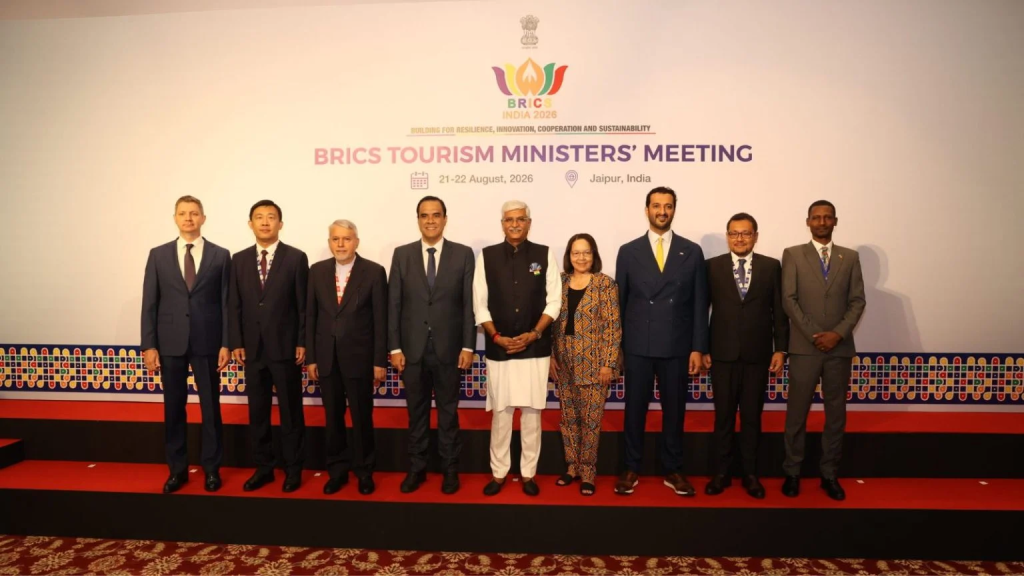
BRICS Tourism Ministers have adopted the Jaipur Declaration in India, creating a framework for cooperation on AI, sustainability, skills development and seamless travel.
BRICS Tourism Ministers have adopted the Jaipur Declaration, creating a framework for stronger tourism cooperation among member countries. The agreement focuses on artificial intelligence, sustainability, skills development and easier travel.
The BRICS Tourism Ministers’ Meeting took place in Jaipur, India, under India’s Chairship. The meeting concluded the BRICS Tourism Track for 2026 under the theme “Building for Resilience, Innovation, Cooperation and Sustainability.”
Jaipur Declaration outlines four tourism priorities
The Jaipur Declaration follows the work of the BRICS Tourism Working Group during India’s Chairship.
The document identifies four main priorities. These are Artificial Intelligence and Tourism, Sustainability and Responsible Tourism, Tourism Skilling and Capacity Building, and Tourism Exchanges and Seamless Travel Facilitation.

The BRICS Tourism Ministers adopted the communiqué by consensus. The document highlights the role of responsible and human-centred artificial intelligence and digital technologies in tourism. In addition, the declaration supports cooperation in tourism planning, destination management, visitor services, multilingual communication and travel facilitation. It also covers sustainable and community-based tourism, protection of natural and cultural heritage, tourism investment, infrastructure development and new tourism products.
Furthermore, the declaration encourages skills development, industry-academia partnerships, tourism data exchanges, sharing of best practices and stronger connections between people.
Nine BRICS countries participate in the meeting
The meeting brought together representatives from nine BRICS member states.
The ministerial participants included Gustavo Costa Feliciano, Minister of Tourism of Brazil; Reza Salehi Amiri, Minister of Cultural Heritage, Tourism and Handicrafts of Iran; Patricia De Lille, Minister of Tourism of South Africa; and Abdulla Bin Touq Al Marri, Minister of Economy and Tourism of the United Arab Emirates.
Delegations from China, Ethiopia, Indonesia and Russia also attended the meeting.
The Indian delegation included Bhuvnesh Kumar, Secretary of the Ministry of Tourism of India, and Harikishore S., Joint Secretary of the Ministry of Tourism of India, together with other officials.
India highlights tourism’s economic contribution

Gajendra Singh Shekhawat, Union Minister for Culture and Tourism of India, chaired the meeting.
ExecutiveBranch
Mr Shekhawat said tourism can extend economic growth beyond major cities. It can also create opportunities in towns, villages and remote regions.
He highlighted tourism’s contribution to hotels, homestays, transport operators, guides, artisans, weavers, farmers and entrepreneurs.
The minister also referred to India’s efforts to develop a tourism ecosystem based on economic growth, environmental responsibility, technology and cultural authenticity.
He said, “Tourism ultimately connects people. It creates opportunities for communities, enables cultural exchange and allows citizens of our countries to understand one another beyond the formal relationships between governments.”
BRICS members discuss future tourism cooperation
Alongside the ministerial meeting, India held bilateral discussions with Brazil, Iran, South Africa and the United Arab Emirates.
ExecutiveBranch
The discussions aimed to advance tourism cooperation and strengthen partnerships between India and its BRICS counterparts.
The meeting also included presentations of traditional arts, crafts and community-based tourism initiatives for ministers and delegates.
On 22 August 2026, participants will visit Jaipur’s heritage attractions, including Hawa Mahal, City Palace and Amber Fort.
The visits will give delegates an opportunity to experience Jaipur’s architectural heritage, cultural traditions, and tourism offerings.