Travel Daily Media raised a major industry question: does staying independent matter or does joining an alliance offer more advantages?
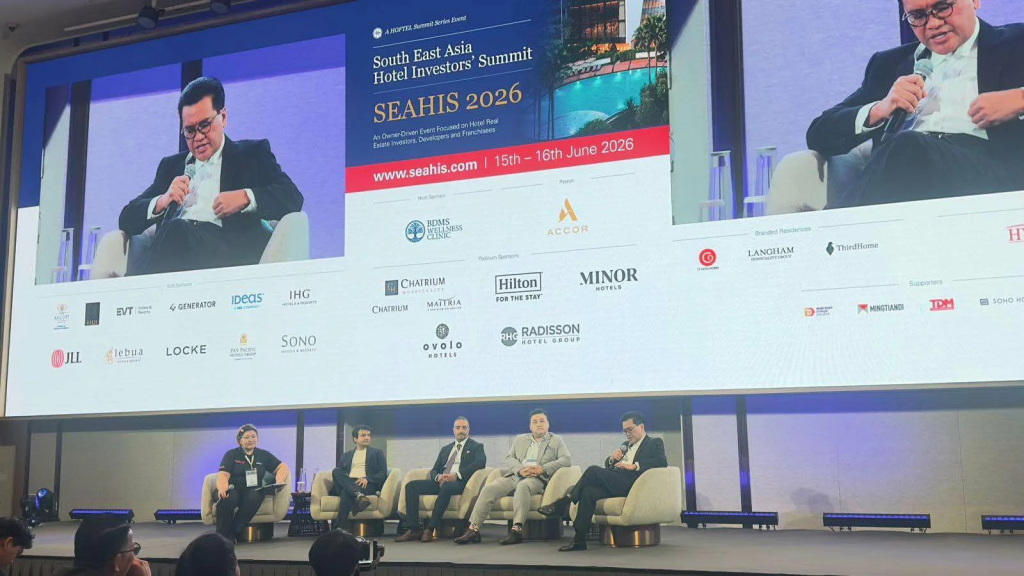
Following up on our recent feature on how small- and medium-scale players are pondering over staying independent or taking on a global franchise, Travel Daily Media moderated the panel Loyalty alliances or franchises: What is the best solution for smaller and medium-sized hotel groups at the South East Asia Hotel Investors’ Summit (SEAHIS) 2026.
This unique panel discussion brought together speakers from both sides of the divide: Plataran Hospitality chief executive Dr Yozua Makes; Ovolo Group chief operating officer Shivang Jhunjhnuwala; Rox Asset’s head of hospitality asset management Cuong Vu; and Indochina Capital Corporation co-CEO and board member Michael Piro.
The discussion revolved around how smaller players are at a crossroads: they are poised to make a choice from opting to stay independent, taking on a franchise, or turn over the reins to a third-party hotel management company.
The Plataran approach: Diplomacy matters
For Makes, current circumstances now require industry players to be seamlessly flexible, opting for collaboration as opposed to turning the reins over entirely to another entity.
As he put it: “We believe there shouldn’t be a compromise per se between maintaining identity and brand collaboration. In the hospitality business there are two very powerful words: authenticity and experience, and that’s where Plataran fits in.”
Interestingly, Plataran has the distinction of being one of the only comprehensive hospitality platforms in Indonesia and has been so since it began operations in 2009.
Aside from being comprehensive in the way it operates, Plataran also prides itself on flexibility, looking at other players as complementary to their operations as opposed to direct competition.
Makes specifically held up his company’s agreement with Japan’s Okura Hotels as an example.
Within the context of this particular alliance, Plataran upholds its ethos on safeguarding nature, emphasising the richness of Indonesian culture, and fostering community spirit through a partnership that allows it to maintain its independence through flexibility.
As such, both entities maintain their respective identities whilst working together to provide exceptional experiences for their shared clientele.
Ovolo: A robust long-term partnership
Given that this particular panel followed a discussion on the recent alliance between Wyndham Hotels & Resorts and the Ovolo Group, Jhunjhnuwala shared his thoughts on the dynamic between the two hospitality players and how it has worked so far.
He said: “Since we opened with [Wyndham on 19th November], we’ve understood a lot of different things about each other. When you go into a relationship, it’s a lot of push and pull; it’s a bit of a dance, a lot of back and forth. Our partnership with Wyndham is a lot more robust because we do have a long-term partnership together; and it’s opened our horizons to a lot of different possibilities.”
The Wyndham partnership isn’t actually the first time that Ovolo has teamed up with a global network to boost distribution for its hotels.
The group was previously part of the Small Luxury Hotels of the World (SLH) which, in turn, partnered with Hilton.
Jhunjhnuwala added: “We weren’t new to having robust distribution coming in from one of the larger networks out there. Wyndham has an arsenal of tools and different levers that we can pull on during different need periods for us. That’s exciting because, again, we’re 100 percent independently owned, but Wyndham understands what we bring to the table as we understand what they bring to the table.”
As a result, the structure of the Ovolo-Wyndham partnership is two-fold: split between development, and with distribution and sales.
Ovolo gets to scale rapidly via hotel management agreements and franchises, but retains the power to decline deals that don’t align with its core values.
Wink Hotels: A compelling case for franchising
For Piro, on the other hand, integrating Wink Hotels’ six-property portfolio with a total of 1,500 keys into a franchise agreement with Hyatt brought about almost immediate results for its bottom line.
To date, the agreement has resulted in a maximum increase of 35 percent for Wink’s average daily rate (ADR), direct bookings six times higher, extensive corporate account penetration among Fortune 500 firms as well as lower negotiated net rates for OTA commissions.
As to what’s next, Piro remarked: “I think the next exercise I have to look into is further optimisation. There is definitely still some redundancy and overlap that I need to work through. For example, as part of our arrangement, we negotiated that Hyatt had to have Vietnamese language provided by native Vietnamese speakers added to their call centres, their local call centres and reservation centres, so that we could reduce our burden that we’re carrying right now and having an entire office full of reservation staff taking calls all day.”
An asset manager’s sentiments
When asked to give an opinion from the asset management side, Cuong Vu pointed out three key elements: location, scale, and future-proofing.
While distribution networks have historically driven these alliances, AI and other technologies are rapidly altering consumer behavior.
Indeed, travellers are bypassing traditional search, even conventional trip planning practices, and asking AI engines for highly contextualized recommendations.
Thus, owners need to assess a partner’s execution capabilities over a five-year period and that the choice between independence and an alliance must ultimately depend on what best serves the individual asset, whether it is a remote eco-resort or a city-center corporate hub.
Cuong opined: ”At the end of the day, when we’re looking at solutions, we want to make sure that we’re delivering something that our partners have the capabilities to do so.”
All things considered, growth matters more than just mere survival for today’s smaller hospitality players, and collaboration with global brands and hotel management companies enables them to thrive without compromising their unique brand identity and ethos.
As Makes put it: “We’re not only surviving: we are excelling. But if we want to do more, we must also be able to distribute, strategise, and to maintain flexibility in terms of expansion strategies when working with other brands or operators.”