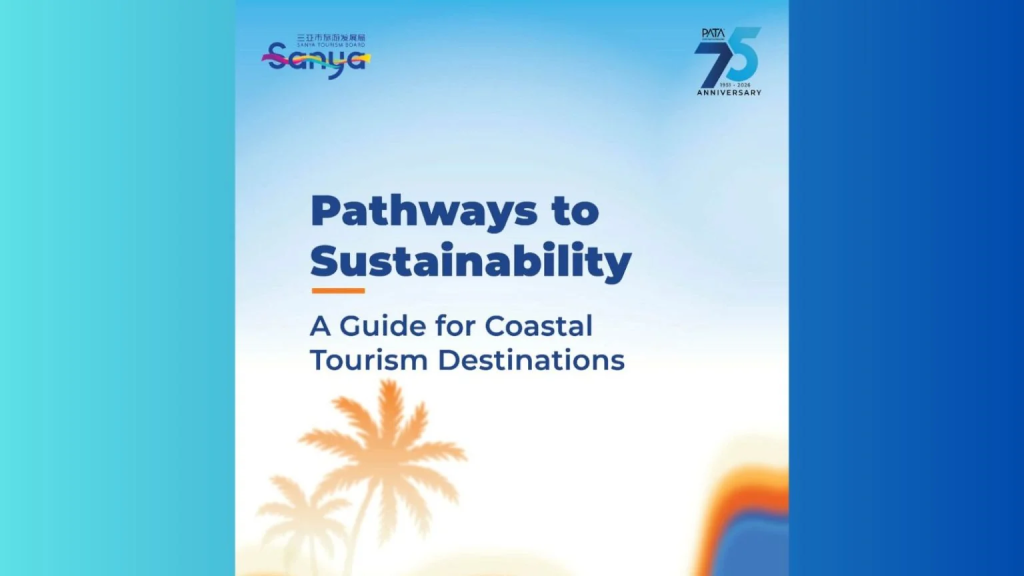
PATA has launched a new report examining 15 coastal and island destinations, highlighting practical approaches to environmental protection, community participation, resource management and sustainable tourism development.
The Pacific Asia Travel Association (PATA) has released a new report examining sustainable coastal tourism through 15 international case studies. Launched on 18 November 2026 in Sanya, China, the publication explores how destinations can balance tourism development with environmental protection and community well-being. The study covers natural, cultural, urban and resort destinations, including eight case studies from Sanya. It also identifies practical approaches to managing visitor flows, protecting ecosystems, and strengthening destination resilience.
- New sustainability research: PATA’s report examines 15 coastal and island tourism destinations, including eight case studies from Sanya, China.
- Four development areas: The study covers natural, cultural, urban and resort destinations, with practical examples of sustainable management.
- Destination priorities: Key recommendations include community participation, environmental monitoring, resource efficiency and measuring tourism value beyond visitor numbers.
PATA launches sustainability guide at Sanya tourism event
The report, titled Pathways to Sustainability – A Guide for Coastal Tourism Destinations, was presented during the 2026 Coastal Tourism Destination Exchange Event. The Sanya Tourism Board hosted the gathering in partnership with PATA.
The publication examines how tourism destinations respond to pressures from climate change, concentrated visitor demand and development. It also considers how governments and businesses can protect the natural and cultural resources supporting their tourism economies.
Noor Ahmad Hamid, Chief Executive Officer of PATA, said:
“Tourism destinations are built upon natural ecosystems, cultural heritage and local communities, which are not simply attractions for visitors but the foundations upon which tourism economies depend.”
He added:
“As tourism continues to expand, destinations must look beyond visitor numbers and consider how to create greater economic value while safeguarding the resources and communities that sustain the industry.”
The study organises its findings into four categories, allowing destinations to examine approaches relevant to their particular conditions.
Natural destinations focus on ecosystem protection and climate resilience
The first section examines conservation and visitor management in natural tourism destinations. Case studies include the Cook Islands, Koh Mak in Thailand and Wuzhizhou Island in Sanya.
Their approaches include environmental charters, destination management plans and coral reef restoration. Furthermore, some destinations use visitor reservation systems and integrated land-use planning to regulate tourism activity.
Wuzhizhou Island provides a detailed example of marine restoration. According to the report, the destination has transplanted more than 66,000 coral colonies and restored approximately 61,000 square metres of reef.
Consequently, nearshore live-coral cover increased from below 15% to 37.08%. The destination also uses ecological monitoring to guide tourism management and conservation activities.
The findings demonstrate how environmental restoration and visitor management can form part of destination planning.
Cultural destinations place communities at the centre of tourism
The second section examines how destinations can protect cultural heritage while generating economic benefits for local communities.
Featured examples include longhouse tourism in Sarawak, Malaysia, Papua New Guinea, West Island Fishing Village and Yazhou Ancient City in Sanya. The report highlights community consent, local decision-making and the protection of traditional practices. These measures aim to give residents greater control over how their heritage is presented to visitors.
Furthermore, the study examines how local enterprises can participate in tourism supply chains. This can help distribute tourism income among businesses and communities involved in preserving cultural traditions.
PATA identifies community participation as an important requirement for maintaining cultural authenticity and supporting long-term tourism development.
Urban tourism destinations address resource efficiency
Urban destinations face different sustainability challenges, particularly concerning land availability, water consumption, energy demand and infrastructure capacity.
The report examines initiatives in Jeju, South Korea, Yas Island, Abu Dhabi, CDF Sanya International Duty Free Shopping Complex and Sanya Joy City. These destinations have introduced measures covering energy-efficient buildings, renewable energy, waste management and improved cooling technologies.
Meanwhile, digital monitoring systems can help operators understand resource consumption and identify opportunities for greater efficiency.
The report also highlights strategies encouraging visitors to explore areas beyond heavily concentrated tourism districts. Such approaches can help destinations distribute visitor activity more evenly.
Resort destinations integrate sustainability into hospitality operations
The fourth section focuses on environmental management within hotels and resorts.
Case studies include El Nido Resorts in the Philippines, resort operations in the Maldives, Ascott Dadonghai Bay in Sanya and Sunshine Yi Hotel.
The report identifies sustainability management teams, responsible procurement and marine conservation among the approaches adopted by hospitality businesses. Other measures include efficient building design, water reuse and staff development. Moreover, the study examines how environmental management can become part of everyday resort operations rather than a separate initiative.
These examples demonstrate different approaches to reducing resource consumption while maintaining hospitality services.
What does PATA’s research mean for tourism destinations?
The findings provide a practical framework for destination management organisations, tourism authorities and hospitality operators.
For coastal destinations, the report highlights the importance of introducing management measures before environmental pressures become difficult to control. Furthermore, it recommends involving residents in decisions concerning tourism development and the distribution of economic benefits.
Another central finding concerns measuring tourism performance. PATA encourages destinations to consider economic value, length of stay and local spending alongside visitor arrivals.
However, approaches cannot necessarily be transferred directly between destinations. Environmental conditions, governance structures, infrastructure and available funding differ considerably. Therefore, local authorities and tourism businesses must adapt successful practices to their own circumstances. Reliable data, monitoring and cooperation between stakeholders will remain important for implementation.
For hospitality businesses, the research also reinforces the need to support sustainability claims with measurable evidence.
PATA calls for stronger cooperation in sustainable tourism development
The report outlines responsibilities for governments, private businesses and local communities in advancing sustainable coastal tourism.
Governments are encouraged to establish planning frameworks and clear environmental policies. Meanwhile, tourism businesses should incorporate sustainability into operations, procurement and investment decisions.
Local communities should also participate in shaping tourism development, particularly where visitor activity affects natural resources and cultural traditions.
Hamid said:
“This report brings together practical experiences from destinations that are already addressing these challenges in different ways. We hope the findings will encourage greater knowledge-sharing and collaboration, while helping governments and industry stakeholders identify approaches that can be adapted to their own circumstances.”
The publication complements PATA’s wider research and capacity-building activities, including its Tourism Destination Resilience Programme and sustainability training initiatives.
With 15 case studies across four destination categories, the report provides examples of how tourism growth can be managed alongside conservation and community priorities. Its findings are intended to support destination planning, tourism policy and operational decision-making.