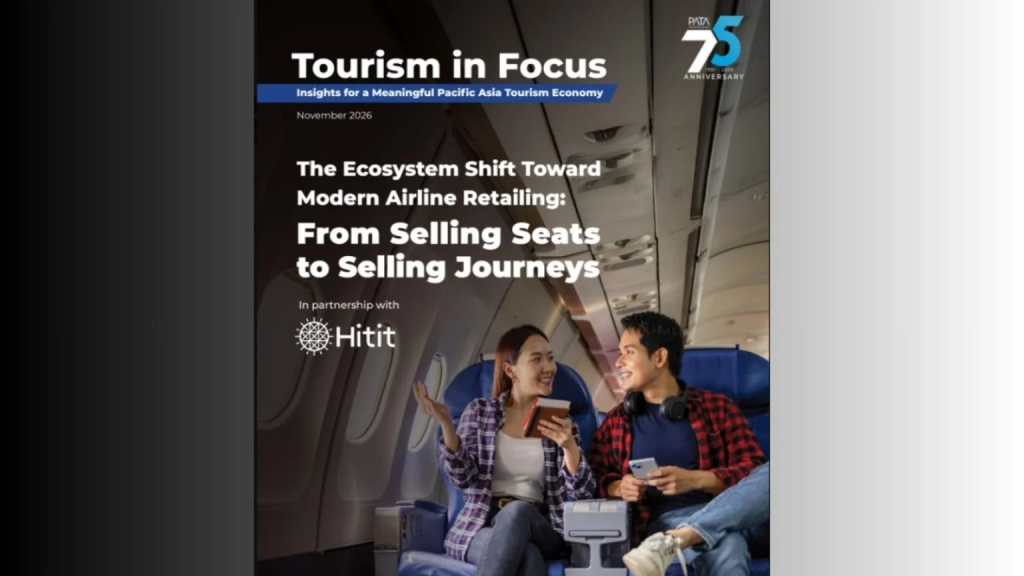
A new PATA report developed with Hitit examines how modern airline retailing could transform airline distribution, travel agency operations and integrated travel services across Asia Pacific.
The Pacific Asia Travel Association (PATA) has published a new report examining how modern airline retailing could transform airline distribution, travel agency operations and the wider tourism ecosystem. Developed in partnership with aviation technology company Hitit, the November 2026 edition of Tourism in Focus explores the industry’s transition from traditional ticketing systems towards an integrated Offers & Orders model. The report identifies significant opportunities for airlines, travel intermediaries and destination service providers, while highlighting the operational challenges involved in replacing legacy technology.
- The PATA and Hitit report examines how modern airline retailing could replace fragmented booking records with integrated Offers & Orders systems.
- Advanced airline retailing practices could unlock up to US$45 billion in global value over the next decade, according to the report.
- Airline transformation is expected to take 18–36 months on average, while agencies, hotels and other tourism providers could benefit from integrated travel distribution.
Airline distribution moves beyond traditional ticketing systems
According to the report, airlines continue to rely on distribution infrastructure originally developed around paper tickets. Traditional systems maintain separate Passenger Name Records (PNRs), electronic tickets and Electronic Miscellaneous Documents (EMDs). Consequently, airlines and their distribution partners must manage several records for individual bookings, payments and additional services.
Modern airline retailing aims to replace this fragmented structure with a more integrated approach to selling and servicing travel products. The model draws on the International Air Transport Association (IATA) Offers & Orders framework, which combines modern distribution capabilities with unified order management.
The report identifies Singapore Airlines, Qantas, Air New Zealand and Cathay Pacific among Asia Pacific carriers already adopting elements of Offers & Orders and New Distribution Capability (NDC). These developments include dynamic pricing, bundled products and new revenue opportunities across distribution channels.
However, the transition involves more than implementing new software. Airlines must also reconsider how they design products, manage customer relationships and coordinate commercial operations with travel intermediaries.
NDC and ONE Order underpin the transformation
The report identifies two IATA standards as central to modern airline retailing. New Distribution Capability, established under IATA Resolution 787, enables airlines to create and distribute more flexible offers. Meanwhile, ONE Order, under Resolution 797, provides a framework for replacing separate booking and ticketing records with a unified order structure.
Under this approach, an airline could manage flights, ancillary services and selected third-party products within one order. The framework could also accommodate different passengers, destinations and transport services, creating a structure closer to contemporary e-commerce platforms.
For passengers, the intended benefits include simplified purchasing, greater control over reservations and easier management of itinerary changes. Airlines and travel agents could also process refunds, modifications and reaccommodation through a consolidated record rather than coordinating multiple systems.
The report refers to IATA’s 2025 Global Passenger Survey, which identified growing expectations for simplicity, personalisation and digital control. These preferences provide part of the commercial rationale for developing more integrated travel retailing systems.
Travel agencies could become integrated travel retailers
One of the report’s central findings concerns the changing role of travel agencies and intermediaries. Traditionally, agencies have operated primarily as distribution channels for airline inventory. However, the Offers & Orders model could enable them to assemble personalised travel products and manage more complex itineraries through a unified system.
This transition could create opportunities for agencies to strengthen customer relationships and expand beyond conventional flight sales. For example, intermediaries could combine air travel with accommodation, ground transport and destination experiences within an integrated retailing environment.
Nevertheless, the report acknowledges that these opportunities require investment in technology and professional skills. Agencies will need systems capable of processing new airline offers and supporting the associated servicing requirements. Furthermore, interoperability between different platforms will remain essential as airlines progress at different speeds.
Asia Pacific presents a particularly diverse operating environment. The region combines full-service and low-cost carriers, international hub airports, island destinations and long-haul travel markets. Consequently, the report argues that standardisation will be important because a single implementation approach cannot accommodate every market.
Hotels and destination experiences enter the airline retailing ecosystem
The implications extend beyond aviation and travel distribution. According to PATA and Hitit, modern airline retailing could allow hotels, ground transport providers and destination experience operators to participate more directly in airline-led retailing systems.
A unified order could eventually incorporate flights, transfers, accommodation and local activities. Such arrangements could reduce fragmentation between different booking stages and provide travellers with a more consistent purchasing experience.
For hospitality operators, integration could create additional distribution opportunities through airline platforms and travel intermediaries. Meanwhile, destination management companies and activity providers could reach customers earlier in the travel planning process.
However, the report presents these capabilities as an emerging direction rather than a universally available service. Commercial adoption will depend on compatible technology, agreements between suppliers and the operational readiness of participating businesses.
Airline transformation could take up to three years
The report estimates that transforming an average airline towards modern airline retailing could take between 18 and 36 months. This timeframe reflects the complexity of replacing established systems while maintaining existing operations and distribution relationships.
Progress also differs across the main technology components. According to the analysis, NDC-driven offer management has advanced more quickly than Order and Delivery capabilities. These latter functions remain at an earlier stage of development for many airlines.
Legacy contracts, technology architecture and investment requirements present further obstacles. As a result, airlines must balance long-term transformation objectives with the need to maintain reliable booking, servicing and settlement operations.
The report highlights IATA’s Reference Business Architecture, which separates airline retailing into five functional domains: Product, Offer, Order, Finance and Delivery Management. This structure allows airlines to introduce new capabilities incrementally rather than replacing their entire Passenger Service System through one major implementation.
For technology providers, the approach increases the importance of common standards and application programming interfaces. It also creates opportunities for airlines to combine solutions from different suppliers, provided their systems can exchange information effectively.
Report identifies potential US$45 billion industry opportunity
The PATA and Hitit publication suggests that advanced airline retailing practices could generate up to US$45 billion in global value over the next decade. However, the document does not provide a detailed calculation or methodology supporting this estimate. The figure should therefore be understood as an indicative opportunity rather than a confirmed revenue forecast.
The report also notes that adoption remains uneven. Although many airlines recognise the importance of Offers & Orders, only a minority have begun comprehensive transformation programmes, according to its assessment.
The differences between early adopters and airlines still operating primarily on legacy systems could shape the pace of industry-wide implementation. Furthermore, technology readiness alone will not determine success, as commercial processes and organisational capabilities must evolve alongside distribution systems.
What modern airline retailing means for travel businesses
For airlines, modern airline retailing could support more flexible product creation, differentiated offers and additional opportunities to sell ancillary services. At the same time, unified orders could simplify accounting, reconciliation and customer servicing. However, these benefits depend on successful integration and changes to existing operating procedures.
For travel agencies and online travel platforms, the transition presents both opportunities and implementation costs. Access to richer airline content could support more personalised products, but intermediaries must maintain compatibility with different airline systems. Consequently, standards-based technology and staff training will become important considerations.
Hotels and destination service providers face a different strategic question. As airlines expand their retailing capabilities, accommodation and local experiences could become part of a wider travel purchasing process. This may create new routes to market, although businesses will need to assess distribution costs, customer ownership and operational responsibilities.
Across Asia Pacific, the region’s diversity makes coordination particularly important. Airlines, intermediaries, technology providers and tourism organisations will need common processes to support cross-border travel products. Without sufficient interoperability, the transition could introduce new complexity instead of reducing existing fragmentation.
PATA and Hitit highlight the need for industry collaboration
The November 2026 Tourism in Focus report was authored by Ilker Duzgoren, Business Development Manager for Retailing and Travel Solutions at Hitit. Duzgoren has more than 20 years of aviation industry experience, including six years at IATA working on passenger data exchange. His background also includes airline reservation systems, interline operations and international aviation technology standards.
The publication concludes that successful implementation will require coordination between airlines, travel agencies, technology providers and destination stakeholders. It also identifies organisational readiness and gradual adoption as important factors in the transition towards Offers & Orders.
As airlines move towards integrated commerce models, the report positions modern airline retailing as a broader business transformation rather than a conventional distribution technology upgrade. Its impact on Asia Pacific tourism will depend on adoption across the travel value chain and the ability of industry participants to deliver compatible services.