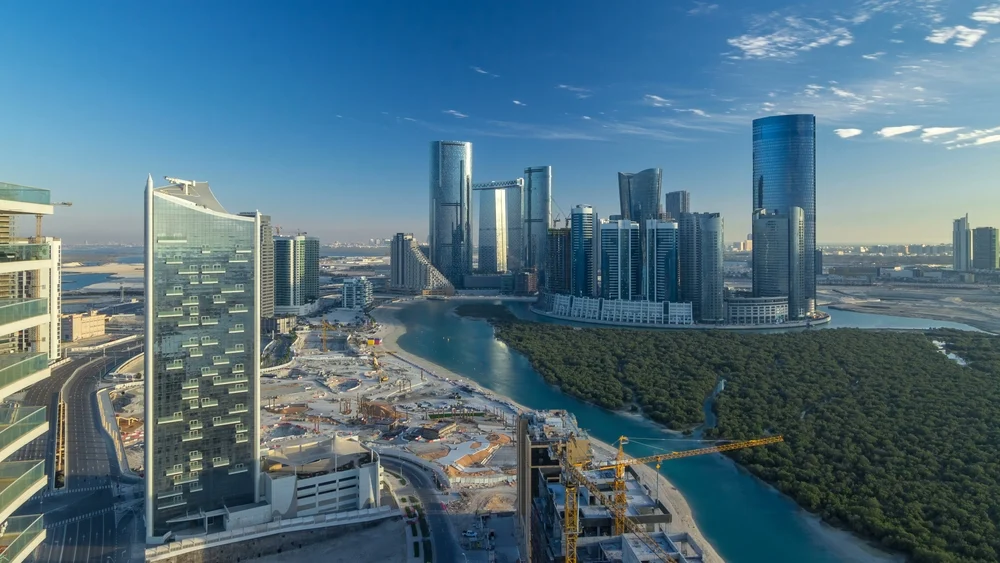
Buildings on Al Reem island in Abu Dhabi timelapse panorama from above. Aerial cityscape of Al Reem Island at evening, showing the reflection of buildings in the water and long shadows.
Abu Dhabi is offering complimentary UAE entry visas to Indian tourists booking through participating travel partners, sharpening its push into a market that has already become the emirate’s largest source of international hotel guests.
The Department of Culture and Tourism – Abu Dhabi (DCT Abu Dhabi) programme runs from August to October 2026, with eligible Indian passport holders able to receive a free visa when booking an Abu Dhabi holiday through selected travel partners. The initiative is aimed at making travel easier for Indian visitors while encouraging more holidays to the UAE capital.
The offer comes with conditions. Travellers must hold an Indian passport, travel from India on a return flight and stay for at least three consecutive nights in an Abu Dhabi hotel as part of an eligible booking. NDTV reported that the visa is tied to qualifying holiday packages rather than being a blanket waiver for all Indian visitors.
For travel agents and tour operators, the commercial appeal is straightforward. Visa charges can materially increase the price of an overseas trip, particularly for families. Removing that cost gives sellers more room to compete on the total package price without relying on hotel discounting. It also comes as Gulf destinations fight harder for a share of India’s expanding outbound market.
India moves to the centre of Abu Dhabi’s tourism strategy
India is no longer an emerging market for Abu Dhabi. It is its biggest international hotel market. Indian hotel guests reached 436,124 in 2025, up 22% year on year. They accounted for 13% of international hotel guests, putting India ahead of Russia, the UK, China and Saudi Arabia.
The increase came during another strong year for the emirate. Abu Dhabi recorded 26.6 million visitors in 2025 and 5.9 million hotel guests, while international arrivals from its leading source markets increased 10%.Those numbers put the latest visa promotion in perspective. Abu Dhabi is not trying to create an Indian market from scratch; it is looking for faster growth from one that already delivers substantial room nights and visitor spending.
Air capacity has followed demand. New IndiGo routes and an Air India Express service added to the connectivity between India and Abu Dhabi in 2025, complementing Etihad Airways’ established Indian network. The breadth of those links matters. It gives tour operators access to travellers beyond Delhi and Mumbai and makes Abu Dhabi practical for short breaks as well as longer family holidays.
DCT Abu Dhabi has also been working more closely with India’s distribution network, bringing travel agencies and tour operators together with Etihad Airways and local tourism businesses. The free-visa offer effectively gives that network another product to sell.

Why Indian travellers are choosing Abu Dhabi
Proximity helps, but Abu Dhabi’s gains in India cannot be explained by flight times alone. The emirate has assembled a tourism mix that maps unusually well onto several large segments of the Indian outbound market. Families can build trips around Yas Island, where Ferrari World Abu Dhabi, Warner Bros. World Abu Dhabi, Yas Waterworld and SeaWorld Yas Island sit within the same leisure district.
Culture has become a stronger part of the proposition too. Louvre Abu Dhabi, Qasr Al Watan and Sheikh Zayed Grand Mosque allow operators to construct itineraries that extend beyond theme parks, malls and resorts. That breadth is increasingly important as Gulf destinations compete for repeat visitors who have already experienced the region’s traditional city-break products.
Four sold-out Coldplay concerts at Zayed Sports City attracted more than 193,000 people in 2025, according to Abu Dhabi authorities. Abu Dhabi T10 cricket drew about 100,000, while cultural and leisure events across the emirate recorded 4.2 million attendees during the year, a 20% increase. Cricket needs little introduction to the Indian market, while international concerts and sporting events provide another reason to travel — and another product for the trade. Flights, hotels, event tickets and attractions can be packaged into trips that would not necessarily have existed as conventional leisure holidays.
The UAE’s large Indian community also creates a base of visiting-friends-and-relatives traffic and gives the destination a degree of familiarity that newer outbound markets must work harder to establish.

Free visa changes the package economics
For an individual traveller, a waived visa fee may be only one component of the holiday budget. Across a family booking, the economics become more interesting. That is where the August-to-October programme could have its greatest effect. Instead of another broad consumer advertising campaign, Abu Dhabi is putting an incentive into the hands of travel intermediaries at the point where customers compare destinations and prices.
Agents can use the saving to reduce the headline package cost, add an attraction or upgrade accommodation. Either way, it gives them some flexibility in a price-conscious market.
The initiative also sits alongside other measures designed to remove friction from an Abu Dhabi trip. In June, Etihad Airways and DCT Abu Dhabi announced complimentary medical travel insurance for eligible international visitors flying to or through Abu Dhabi on Etihad-operated services. The programme applies to qualifying travel between July 1 and December 31, 2026, and provides cover for up to 15 days without requiring a separate application, according to Etihad Airways.
The approach also reflects a wider shift in destination marketing. Visa facilitation, air access and distribution partnerships are increasingly being used alongside traditional advertising as destinations chase Indian outbound demand. For tourism boards, removing friction in the booking process can be as valuable as generating awareness.
Abu Dhabi has been moving on several of those fronts. Etihad Airways and DCT Abu Dhabi have also introduced complimentary medical travel insurance for eligible international passengers travelling to or through Abu Dhabi between July and December 2026, covering qualifying travellers for up to 15 days without a separate application.
Individually, such measures are relatively modest. Together, they make the destination easier for the trade to package and sell.

The battle for India’s outbound market
Abu Dhabi’s challenge is that it is hardly alone in recognising India’s potential. Destinations across the Gulf and Asia are competing for the same traveller through additional air capacity, simpler entry requirements, trade partnerships and targeted promotions. Indian travellers, meanwhile, have a widening choice of short- and medium-haul destinations.
That raises the stakes for Abu Dhabi. The emirate needs to convert rising arrivals into longer stays and greater spending while building enough depth in its tourism product to encourage repeat visits. There is also a positioning question. Abu Dhabi has long benefited from its role as an aviation hub, but its tourism strategy increasingly depends on convincing passengers to stay rather than simply connect — and on persuading Indian travellers to choose the emirate as the primary purpose of the trip.
The expansion of Yas Island, investment in cultural attractions and a growing calendar of concerts and sporting events have helped that transition. Stronger air links have done the rest. Now the visa offer adds price to the equation.
With more than 436,000 Indian hotel guests already recorded in 2025, Abu Dhabi does not need a dramatic shift in traveller behaviour for the programme to produce meaningful gains. Even incremental growth can generate significant additional hotel nights, attraction sales and business for destination management companies.
The more revealing test will come after October. If participating agents report stronger conversion and incremental bookings rather than travellers simply taking advantage of a benefit on trips they would have booked anyway, the programme could provide a case for extending visa-led incentives or deploying them during future booking periods.