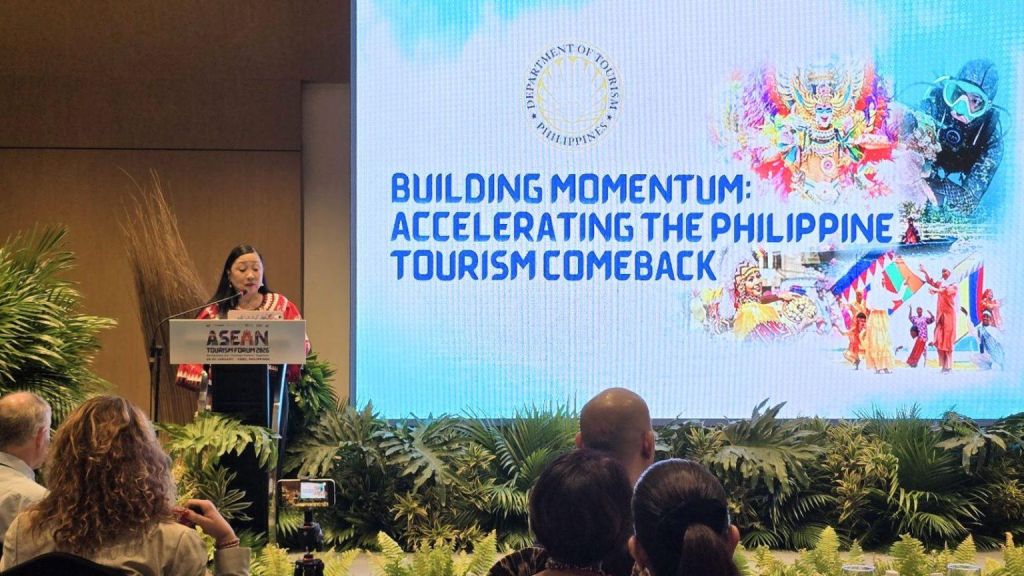
Philippines tourism development was outlined at ATF 2026 in Cebu, with officials detailing recovery data, connectivity expansion, policy reforms and a diversified, inclusive tourism strategy.
Philippines tourism development was presented in detail during the ASEAN Tourism Forum (ATF) 2026 and TRAVEX in Cebu, where senior government and tourism promotion officials outlined the country’s recovery, policy direction and medium-term priorities. The Philippines is hosting ATF and TRAVEX in Cebu for the first time, alongside its upcoming ASEAN Chairship in 2026, positioning tourism as a central pillar of national development.
Opening the country briefing, Verna C. Buensuceso, Undersecretary for Tourism Development at the Department of Tourism, underlined the strategic importance of the sector.
“You know, tourism is a key driver of national development and nation building,” she said.
International arrivals rebound and economic contribution strengthens
According to data presented at ATF 2026, Philippines tourism development has entered a strong recovery phase following the pandemic. International arrivals increased from just 163,879 visitors in 2021 to almost 6.5 million visitors projected for 2024–2025, signalling renewed confidence in the destination.
“We are not just recovering, we are actually building momentum,” Buensuceso said. “Each step forward proves that the Philippines has the demand, the products and the people.”
Inbound tourism expenditure in 2025 is estimated at approximately PHP 694 billion, underlining tourism’s growing contribution to the wider economy and its multiplier effects across transport, accommodation, food services and local supply chains.
Visitor behaviour data further reinforces this trend, with an average length of stay of 11.9 days and average daily spending of around US$122.
“This strongly signals the value perception and diversified trip patterns,” Buensuceso noted.
Policy reforms supporting frictionless travel
To sustain Philippines tourism development, the Department of Tourism has introduced a series of policy reforms aimed at reducing travel barriers and stimulating higher-value visitation.
- Visa-free entry for Indian, Taiwanese and Chinese nationals
- Visa waivers for cruise passengers
- Introduction of a digital nomad visa targeting long-stay remote workers
- Planned rollout of a VAT refund scheme for tourists
“So the important thing right now is really to promote frictionless travel,” Buensuceso said.
Bilateral tourism agreements with Brunei, India, Israel, Japan, Korea, Thailand and Qatar are being leveraged to support visa liberalisation, lower travel advisories, facilitate new air routes and encourage cooperation in policy, standards, investment and product development.
“These agreements turn diplomacy into real tourism outcomes,” she added.
Expanding international and domestic connectivity
As an archipelago of more than 7,600 islands, connectivity remains fundamental to Philippines tourism development. The Department of Tourism highlighted new and expanded international routes connecting Manila and Cebu with San Francisco, Seattle, Vancouver, New Delhi, Guam, Perth, Brisbane and Paris.
Regional connectivity across Asia has also been strengthened, with services to destinations including Cebu, Clark, Iloilo, Bohol, Kalibo and Caticlan. Chartered flights from Russia and Mongolia have been introduced, while domestic connectivity has expanded through new routes linking Clark, Cebu, Davao and Iloilo with island destinations such as Coron, El Nido, Siargao and Boracay.
“These new connections make the Philippines more accessible and help spread tourism benefits across the regions,” Buensuceso said.
Visitor infrastructure, health tourism and service quality
Philippines tourism development initiatives also focus on improving visitor experience, safety and service quality. Health and wellness tourism has been strengthened through the launch of a 24/7 Tourist Medical Concierge, which has already assisted more than 20,000 tourists from 76 countries.
“What we want to do is really to ensure a smooth and dignified experience from arrival to their onward journey,” Buensuceso said.
Visitor convenience is being enhanced through the establishment of Tourist Rest Areas, with 12 already operating nationwide and a long-term target of 100 facilities across Luzon, Visayas and Mindanao.
Workforce development remains a priority, with more than 412,000 tourism workers trained under the Filipino Brand of Service Excellence programme, embedding consistent service standards rooted in Filipino core values.
Inclusive growth and community-based programmes
Inclusive growth forms a core component of Philippines tourism development, with programmes designed to support MSMEs, tourism workers and local communities.
- Turismo Asenso Loan Programme for tourism MSMEs
- Livelihood and recovery support for workers affected by calamities
- Capacity-building initiatives for returning overseas Filipino workers
- Engagement of senior citizens as community guides and cultural ambassadors
- Professional support and insurance coverage for licensed tour guides
“This is a testament to our commitment to be inclusive and people-centred,” Buensuceso said, describing tour guides as “frontliners in cultural diplomacy.”
Diversifying tourism products and experiences
The Department of Tourism outlined diversification as a strategic pillar of Philippines tourism development. Updated National Accommodation Standards now incorporate “Filipinisation” indicators, encouraging hotels and resorts to integrate Filipino culture across guest touchpoints.
Muslim-friendly tourism has advanced, with the Philippines rising from 12th to 8th place in the Global Muslim Travel Index and the opening of Marhaba Boracay, the country’s first Muslim-friendly beach cove.
Gastronomy tourism is being strengthened through the Philippine Experience programme, the Gastronomy Tourism Roadmap, the hosting of the UN Tourism Regional Forum on Gastronomy Tourism, and increased international recognition following inclusion in the Michelin Guide.
Additional growth segments include cultural and creative tourism, dive tourism with expanded safety infrastructure, golf tourism supported by more than 117 courses nationwide, sports tourism, film tourism, MICE and cruise tourism, as well as destination recovery initiatives such as the Visit Cebu campaign.
TPB strategy, marketing priorities and sustainability
Addressing delegates, Maria Margarita M. Nograles, Chief Operating Officer of the Tourism Promotions Board Philippines, outlined TPB’s role as the Department of Tourism’s marketing and B2B engagement arm.
“We are the marketing arm of the Philippine Department of Tourism in charge of our travel trade shows and strategic business to business engagements here at home and abroad,” she said.
Nograles presented the Tourism Promotions Board’s strategic direction for 2025–2028, describing a “whole-of-nation” approach anchored on evidence-based marketing, expanded brand reach, positioning the Philippines as a premier MICE destination, and building purposeful, sustainable partnerships.
She also highlighted TPB’s sustainability agenda, aligned with the UN Sustainable Development Goals.
“Our programs are built upon education, environmental conservation, heritage preservation and community assistance,” Nograles said.
Both speakers emphasised continued collaboration with industry stakeholders and the media, positioning Philippines tourism development as a long-term, inclusive and internationally competitive strategy within ASEAN and the global tourism landscape.