Indonesia’s tourism sector has returned to pre-COVID levels and is now advancing a quality tourism strategy focused on experiences, sustainability, digital tools, and diversified destinations.
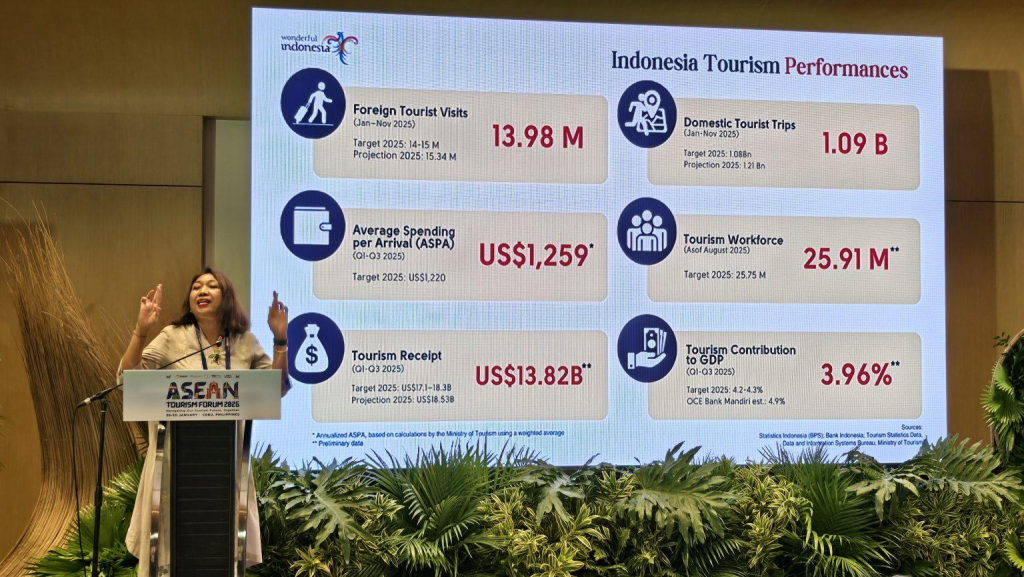
Indonesia’s tourism sector has completed its post-pandemic recovery and is now entering a new phase shaped by the Indonesia Quality Tourism Strategy, according to an update presented at the ASEAN Tourism Forum and TRAVEX 2026 in Cebu, Philippines, by the Deputy Minister for Marketing at the Ministry of Tourism, Ni Made Ayu Marthini. The strategic focus has shifted from volume-driven growth to experience-led, higher-value tourism supported by infrastructure development, workforce upskilling, and digital innovation.
Tourism recovery and 2023 performance
By 2023, Indonesia had returned to pre-COVID levels of international tourism. Foreign arrivals reached almost 14 million by November, placing the country on track to meet its full-year target of 14–15 million visitors. At the same time, domestic tourism expanded sharply, with 1.1 billion domestic trips recorded during the year.
Tourism’s economic role strengthened further, with 25.9 million people employed across the sector and tourism’s GDP contribution reaching 3.96% by the third quarter of 2023. Average length of stay also improved, rising to 10.4 days per international visitor.
2024 targets and economic outlook
For 2024, the Ministry of Tourism has set higher benchmarks aligned with the Indonesia Quality Tourism Strategy, focusing on value creation and long-term sustainability.
- 16–17 million foreign tourist arrivals
- Higher average spending per international visitor
- Tourism foreign exchange earnings of USD 22–24 billion
- 1.18 billion domestic trips
- 26.53 million tourism jobs
- GDP contribution of 4.6%
Strategic pillars and priority markets
Tourism promotion efforts focus on 15 priority source markets. Malaysia and Singapore remain key due to proximity and strong connectivity, while India and Saudi Arabia are identified as strategic growth markets.
A central element of Tourism 5.0 is digital transformation. In November 2023, the Ministry launched “Maya” (Meticulous AI of Intelligence Indonesia), an AI-powered platform designed to deliver personalised travel information and act as a virtual travel companion. The platform has recorded more than 600,000 users since launch.
Destination development and geographic focus
Destination development is concentrated on selected areas to maximise readiness and economic impact. Priority locations include Lake Toba in North Sumatra, the Riau Islands (Batam and Bintan), and Belitung Island.
Established gateways such as Jakarta, Bali, and Batam/Bintan continue to account for around 70% of international arrivals. At the same time, development continues in Borobudur, Mandalika, Labuan Bajo, Wakatobi, Raja Ampat, and Morotai.
Experience-led growth and quality tourism
Indonesia’s flagship positioning under the “Go Beyond Ordinary” campaign places quality at the centre of destination development. The Indonesia QualityTourism Strategy prioritises visitor satisfaction, service standards, and infrastructure readiness.
- Cleanliness and waste management initiatives, with pilot projects in key destinations
- Upskilling and reskilling of the tourism and hospitality workforce
Diversified tourism experiences
Wellness tourism
Indonesia ranks among the leading global destinations for wellness, spa, and complementary medicine. New offerings such as Javanese yoga are being developed beyond Bali, including in Solo and Yogyakarta.
Marine tourism
Marine tourism leverages globally recognised assets such as Raja Ampat and North Sulawesi. Traditional “Finisi” liveaboard experiences support multi-island exploration across key marine corridors.
Gastronomy tourism
Ubud in Bali has been recognised by UN Tourism as a global gastronomy prototype. National initiatives promote more than 3,000 Indonesian recipes through gastronomy festivals and curated culinary guides.
Arts, culture, and design
Indonesia’s more than 700 ethnic cultures underpin curated cultural experiences, traditional textile promotion, and improved museum infrastructure, supporting higher-value cultural tourism.
Muslim-friendly tourism and tourism villages
As a majority Muslim country, Indonesia offers comprehensive halal and Muslim-friendly tourism services, with structured promotion across 15 provinces.
Tourism villages also play a central role in inclusive and community-managed tourism development, supported by training programmes and international recognition.
Events, MICE, and economic impact
In 2023, the Ministry of Tourism supported 99 major events, including national, international, and MICE activities. These events generated significant economic impact and supported approximately 260,000 jobs.
ASEAN cooperation and connectivity
ASEAN remains Indonesia’s largest source market, particularly for repeat visitation. Regional cooperation focuses on improving air connectivity and advancing a long-term vision of ASEAN as a single destination.
Connectivity challenges and digital facilitation
Air capacity remains constrained post-pandemic, with fewer operational aircraft compared to pre-COVID levels. Current strategies prioritise load factor optimisation and low-season demand stimulation.
The government has also launched the “All Indonesia” application, integrating customs, health, and immigration processes into a single digital platform to improve arrival efficiency.
Policy clarifications and market strategies
Proposals such as requiring bank statements for tourists entering Bali remain local initiatives and are not central government policy. Any such measures would require a formal legal framework.
For India, a “Bali +1” strategy encourages travel beyond Bali to destinations such as Yogyakarta, supported by expanded air connectivity. Cooperation with Egypt and other Arab markets is also under exploration.
Overall, the Indonesia Quality Tourism Strategy reflects a shift toward higher-value, experience-driven tourism, positioning Indonesia for sustainable competitiveness in the global travel market.