The country is at the Start of a Long-Term Tourism Growth Cycle
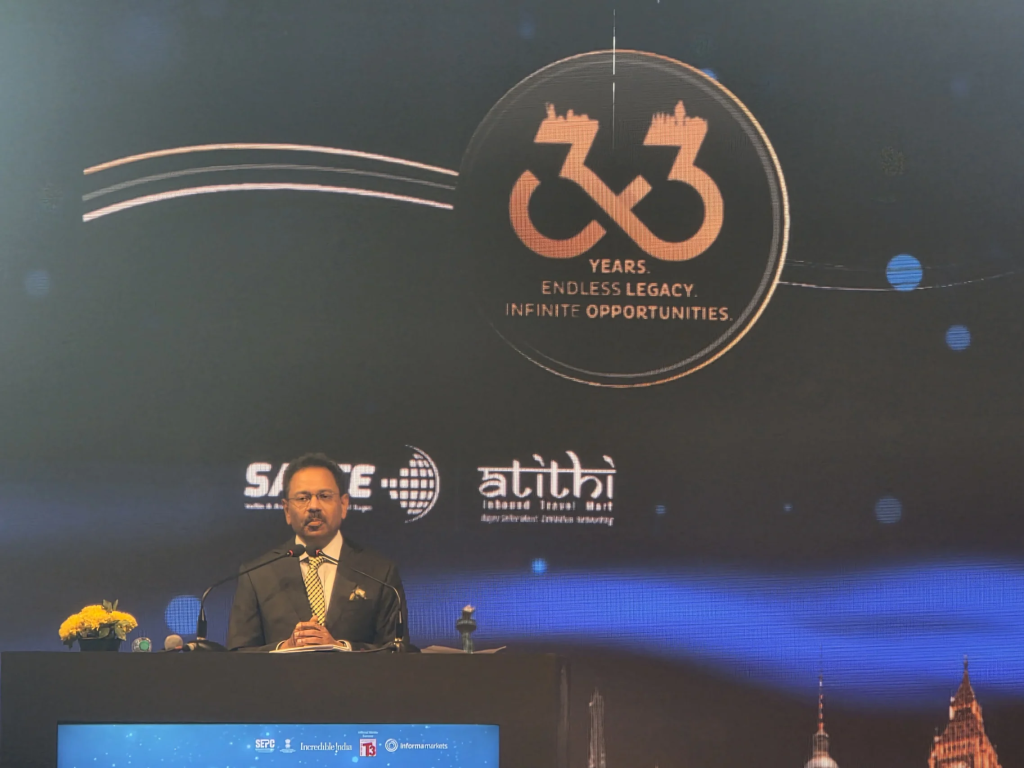
Speaking at the opening ceremony of SATTE 2026, Suman Billa, IAS, Director General & Additional Secretary, Ministry of Tourism, Government of India, underscored India’s strong tourism fundamentals and long-term growth trajectory. arking the 33rd edition of SATTE, Billa reflected on the event’s evolution since he first attended in 2004. “Since then, SATTE has grown and truly blossomed into a world-class platform,” he said, complimenting the organisers for building it into a globally recognised property. He also highlighted the role of the Yashobhoomi convention centre in enabling India to host large-scale international events.
Demand Outpacing Supply
Billa described India as “one of the rare countries where demand is significantly ahead of supply,” positioning it as a compelling market for tourism investors and stakeholders.
India currently receives approximately 20 million inbound tourists annually, generating around USD 32 billion in foreign exchange earnings. At the same time, 30 million Indian outbound travellers spend an estimated USD 37 billion overseas each year.
However, the most significant opportunity lies in the domestic market. “The real story is India’s domestic tourism economy,” Billa noted. Domestic travel volumes surged from 2.4 billion to nearly 3 billion trips in the past year — a growth of close to 40 per cent — partly driven by the Kumbh Mela, but also reflecting broader structural momentum.
Even discounting one-off events, he emphasised that domestic demand continues to grow at pace, creating a substantial supply gap across infrastructure, accommodation and services. “This makes India one of the most favourable markets globally for tourism business,” he said.
Two Strategic Priorities
Billa outlined two key strategic tracks being pursued by the Ministry of Tourism under the leadership of the Honourable Minister.
- Enabling Ease of Travel
India has made rapid progress in physical infrastructure. Over the past decade:
- The number of operational airports has doubled from 75 to 150, with 30–40 more expected in the next five years.
- National highway networks have expanded significantly.
- Semi-high-speed Vande Bharat trains are enhancing connectivity.
- Airports and hospitality infrastructure meet global standards.
The next phase, Billa explained, is to enhance predictability and seamlessness in travel through digital integration.
The Ministry is working to leverage India’s Digital Public Infrastructure (DPI) to create an “India Tourism Digital Stack,” built on:
- Digi Yatra for seamless airport processing through facial recognition
- DigiLocker for digital credentialing
- Unified Payments Interface (UPI) to enable frictionless digital transactions for international visitors
- Open Network for Digital Commerce (ONDC) to make even the smallest tourism players globally discoverable and market-accessible
“The objective is to bring ease, predictability and seamlessness to travel in India,” Billa said.
- Improving Ease of Doing Business
On the supply side, Billa acknowledged the need to accelerate capacity creation.
India currently has approximately 180,000 branded hotel rooms and around 1.5 million unbranded rooms. However, industry estimates suggest that the country requires nearly double its current inventory to meet projected demand.
The Ministry recently convened industry leaders to identify bottlenecks and accelerate reforms. Key focus areas include:
- Deregulation and rationalisation of approvals
- Greater predictability in licensing and clearances
- Reforms in capital structures
- Encouraging states to introduce targeted incentives and subsidies
“Our effort is to create the right conditions for industry to respond,” Billa said, adding that unleashing market forces will be critical to bridging the supply gap.
A Long-Term Bet on India
Positioning India at the beginning of a sustained tourism growth cycle, Billa delivered a clear message to investors and global stakeholders attending SATTE:
“What you are seeing today is only the tip of the iceberg. If you are betting on India, take a long-term view. Be ambitious, invest where the opportunity lies — and you will thank us a few years down the line.”
He concluded by thanking participants and wishing them a successful SATTE 2026.