PATA forecasts Asia Pacific inbound tourism to exceed pre-pandemic levels from 2026, reaching up to 761 million arrivals by 2028 amid geopolitical and economic uncertainties.
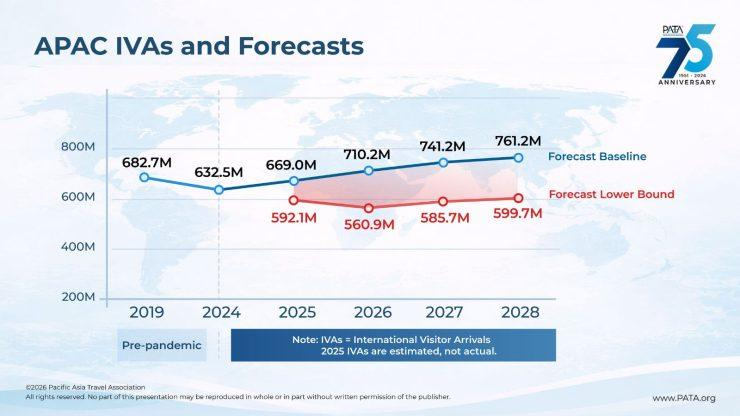
The Pacific Asia Travel Association (PATA) has released its PATA Asia Pacific Visitor Forecasts 2026–2028, projecting that inbound arrivals to the region will exceed pre-pandemic levels from 2026 onwards, reaching a baseline of 761.2 million by 2028.
The report also outlines a lower-bound scenario, reflecting ongoing geopolitical and macroeconomic uncertainty, under which international arrivals could reach 599.7 million by 2028, representing approximately 88% of 2019 levels.
Key findings from the Asia Pacific visitor forecasts
Geopolitical tensions and conflicts continue to pose risks to travel demand and cross-border mobility, contributing to a structurally constrained and uneven recovery across the region.
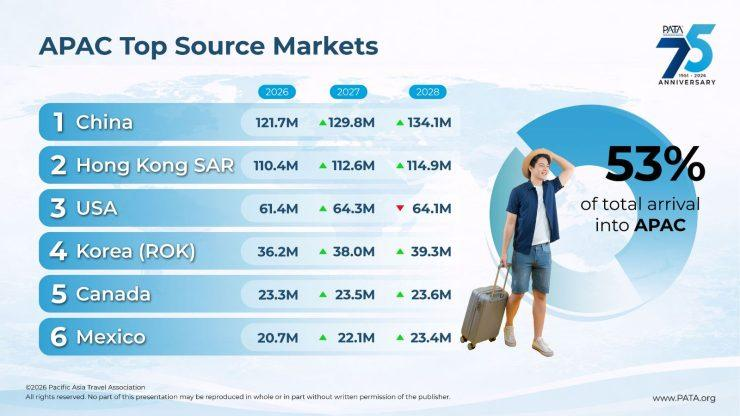
Major destination markets including China, the United States and Türkiye are projected to remain the leading inbound destinations through 2028, while source markets such as China, Hong Kong SAR, the United States and Korea (ROK) continue to play a dominant role despite aviation capacity and cost pressures.
Destinations including Japan and Hong Kong SAR are expected to improve their rankings in the post-pandemic period, reflecting strong recovery momentum.
In terms of recovery performance, Mongolia, Japan, Chile, the Maldives and Sri Lanka are projected to exceed 150% of their 2019 visitor levels, leading the region’s rebound.
By 2028, 27 of the 39 destinations included in the forecast are expected to surpass pre-pandemic arrival volumes.
The report highlights that the recovery trajectory will be shaped by multiple factors, including geopolitical uncertainty, climate-related disruptions, evolving aviation and visa policies, and the increasing role of digitalisation and artificial intelligence across the tourism economy.