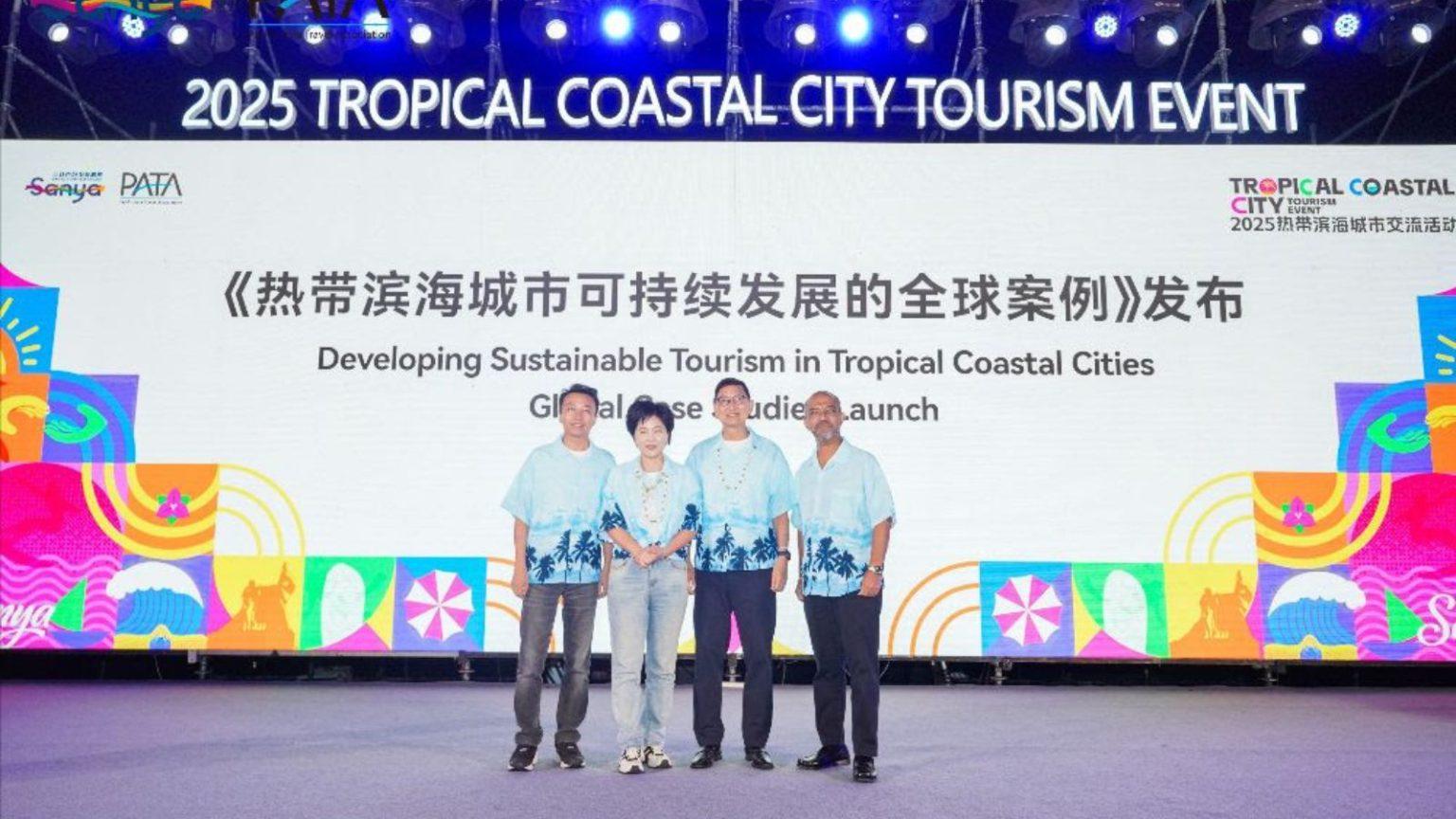
Photo (L/R): Hao Zhang, Vice Director General, Sanya Tourism Board; Lynn Wu, Secretary of the Party Committee, Sanya Tourism Board; Soon-Hwa Wong, Ambassador for Greater China, PATA; and Noor Ahmad Hamid, CEO, PATA, at the launch of the PATA report Developing Sustainable Tourism in Tropical Coastal Cities: Global Case Studies during the 2025 Tropical Coastal City Tourism Event in Sanya, China.
PATA has released a new report outlining global best practices for sustainable tourism in tropical coastal cities, launched during the 2025 Tropical Coastal City Tourism Event in Sanya, and featuring case studies from Asia Pacific destinations.
The Pacific Asia Travel Association (PATA) has released its latest publication, Developing Sustainable Tourism in Tropical Coastal Cities: Global Case Studies, during the 2025 Tropical Coastal City Tourism Event in Sanya, China. The report offers an in-depth analysis of the challenges facing tropical coastal destinations and highlights global examples of best sustainable practices relevant to the Asia Pacific region.
Launched on 18 November, the report introduces a strategic framework built around four core pillars: effective resource management, balanced interaction between visitors and residents, economic and product diversification, and the broad adoption of sustainable practices across the private sector. These components aim to guide coastal destinations toward more resilient, climate-ready tourism models.
During the launch, PATA CEO Noor Ahmad Hamid underlined the urgency of addressing sustainability in coastal regions. He noted that climate-related threats, including unprecedented sea-surface temperatures in the South-West Pacific reported by the World Meteorological Organisation, are intensifying pressures on already fragile ecosystems. He emphasised that unregulated visitor flows and environmental negligence add further strain.
Hamid stated that coordinated action and knowledge-sharing are essential for progress, positioning the new report as a tool for destination leaders seeking practical insights. The report was released in collaboration with the Sanya Tourism Board, which hosted the 2025 Tropical Coastal City Tourism Event as a platform for joint learning among coastal tourism stakeholders.
The publication features detailed case studies from regional destinations demonstrating successful applications of sustainable tourism principles. In Sanya, Wuzhizhou Island has developed China’s first national-level marine ranch demonstration zone, supporting coral reef restoration and the recovery of marine biodiversity. Its “Zero-Waste Tourism Attraction” designation and its role as a coral restoration base for the UN COP15 Youth Biodiversity Expedition reflect its commitment to environmental stewardship.
Thailand’s case study focuses on water resource planning. By establishing a national database to distinguish tourism and residential water demand, the country aims to secure reserves during high-season peaks. Complementary fiscal policies and public awareness campaigns support broader water conservation goals, while protecting special ecological zones enhances natural water absorption and reduces urban flooding.
The Indonesia chapter highlights the Desa Potato Head Resort, which has adopted a rigorous Environmental Management Program developed with Eco Mantra. The property achieved a 97.5% recycling rate in 2023 and is advancing initiatives such as installing solar power and developing Styroshell, a material that converts recycled styrofoam into usable guest amenities.
Together, these examples illustrate how targeted policies, technological innovation, and community engagement can converge to support long-term sustainability in coastal tourism environments.