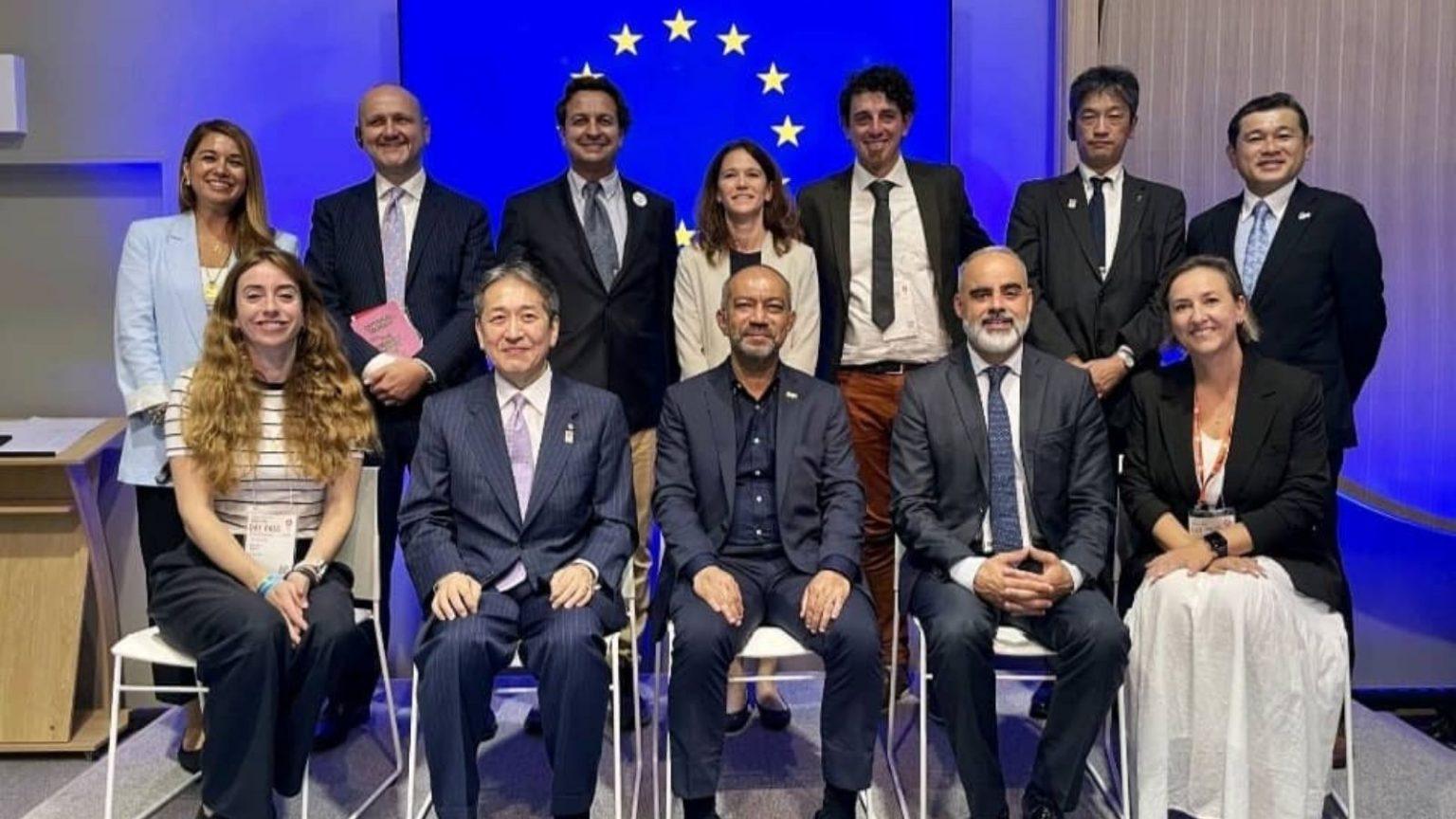
PATA CEO Noor Ahmad Hamid urged stronger Japan–EU cooperation at World Expo 2025, highlighting sustainable growth and balanced tourism strategies.
The Pacific Asia Travel Association (PATA) reaffirmed its commitment to advancing sustainable and balanced tourism between Asia and Europe, as Chief Executive Officer Noor Ahmad Hamid delivered the keynote address at the event “Shaping the Future of Japan-EU Travel”, held at the EU Pavilion during World Expo 2025 in Osaka, Japan.
The event was officiated by Apostolos Tzitzikostas, Commissioner for Sustainable Transport and Tourism at the European Commission, and Takeshi Nakano, Vice Commissioner of the Japan Tourism Agency (JTA). It was organised by the European Travel Commission (ETC), one of PATA’s key partners, represented by CEO Eduardo Santander, in collaboration with the European Union and supported by the Japan Tourism Agency, a public body under Japan’s Ministry of Land, Infrastructure, Transport and Tourism (MLIT).
With tourism flows between Japan and the European Union still heavily concentrated in a few popular destinations, the programme explored ways to promote smarter and more balanced growth in two-way travel. Discussions focused on diversifying travel patterns, strengthening cross-border connectivity, and targeting responsible travellers through coordinated marketing and promotion initiatives.
“First and foremost, I must express my gratitude to Eduardo Santander, CEO of ETC, his esteemed team, and Marlene Bartes, Policy Officer, Directorate-General for Education, Youth, Sport and Culture of the European Commission, for extending the invitation to PATA,” Hamid noted. “I am honoured to be part of this important dialogue that not only strengthens the cross-regional bond between Japan and the EU, but also creates new opportunities for the Asia Pacific region in advancing cooperation, knowledge exchange, and sustainable growth in tourism.”
Hamid underlined the importance of this relationship: “The relationship between Japan and the European Union is one of the most significant economic and cultural corridors in the world. Tourism is not merely a component of this relationship; it is a primary driver of it, fostering mutual understanding and generating substantial economic value. According to FITUR, Japanese travel to the EU is projected at 4.87 million for this year, representing a staggering 67% increase from 2023. This signals a powerful, pent-up demand for long-haul, high-value European travel experiences.”
While acknowledging the positive trends in travel recovery, Hamid also highlighted the growing challenges of mass tourism and carbon emissions. To address these, he proposed applying PATA’s Integrated Destination Facilitation framework to Japan-EU travel, a model built around four strategic pillars:
- Enabling Policies: Managing visitor distribution away from overcrowded destinations and mitigating economic pressures on local communities.
- Smart Infrastructure: Investing in transport connectivity, especially rail networks, to open access to secondary and tertiary destinations.
- Targeted Marketing: Transitioning from volume-driven to value-driven strategies that attract high-yield, low-impact travellers.
- Community Engagement: Empowering local populations to actively participate in tourism, ensuring economic benefit and cultural preservation.
The session underlined PATA’s growing influence as a facilitator of international cooperation in sustainable tourism and reaffirmed its commitment to helping destinations in both Asia and Europe build a more resilient, inclusive, and balanced travel ecosystem.