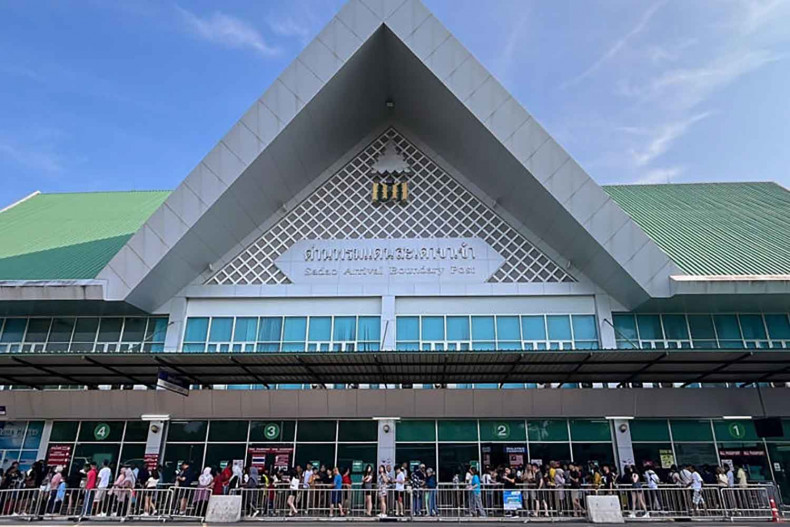
Tourists queue at the Sadao border checkpoint in Songkhla province bordering Malaysia in April last year.
Despite the target for Malaysian tourists having been cut to 5 million this year, equivalent to the level seen in 2024, this market may reach the same number of arrivals as the Chinese as it is still unfazed by the situation along the border provinces.
Patsee Permvongsenee, executive director of the Asean, South Asia and South Pacific region at the Tourism Authority of Thailand (TAT), said there is still hope for the Malaysian market amid sluggish Chinese arrivals.
As of Aug 17, Thailand welcomed over 2.87 million Malaysian tourists, the second-largest inbound market, trailing Chinese arrivals by only 60,000. There was a week in early July when Malaysian arrivals even exceeded those from China.
Mrs Patsee said that since over 70% of arrivals entered via the land border, TAT is holding promotional campaigns and regular events in those areas to attract repeat visitors on a monthly basis, such as the illumination art event “Vijitr at Hatyai” from Aug 29–Sept 21.
“Malaysians now visit Thailand via the border more on weekdays, not only weekends,” she said.
However, even though TAT earlier targeted at least 5.2 million Malaysian tourists, banking on its high potential, it has now revised down the target to around 5 million arrivals for this year.
She said China has heavily discounted tour packages and airfares in a bid to lure Malaysian tourists, in direct competition with Thailand.
Last month, China and Malaysia announced a mutual visa-free agreement to boost trade and tourism.
Songchai Mungprasitthichai, president of the Songkhla Tourism Promotion Association, said the total number of Malaysian tourists this year could match Chinese arrivals, as the latter group is expected to record fewer than 6.7 million, or lower than the number recorded in 2024.
During Malaysia’s Independence Day holiday on Aug 31, Hat Yai should welcome over 5,000–10,000 Malaysian tourists a day, boosting hotel occupancy rates to almost full, said Mr Songchai.
He said arrivals could increase by 20–30% around Sept 16, which is Malaysia Day, a more popular period for travel.
Last week, Malaysia’s State Tourism, Culture, Arts and Heritage Committee advised its citizens to postpone visiting Thailand following a bomb attack in Tak Bai, Narathiwat.
However, Mr Songchai said Malaysian tourists are familiar with the social and tourism situation in Thailand and are unfazed by negative news, including Thailand–Cambodia border skirmishes and unrest in the deep South, as they acknowledge that the dispute does not target foreign visitors.
The fire attack earlier this month on Malaysian tourists in Bangkok only had a short-term impact, he added.
Mrs Patsee said there has been no official announcement from the Malaysian embassy advising against visiting Thailand due to the recent bomb attack.
She said tourists can still visit attractions in southern provinces by exercising caution and avoiding pathways or places with frequent bomb attacks, and are advised to closely follow the news.
The planned 200,000 round-trip domestic flight giveaway to foreign tourists between September and November could encourage Malaysians to visit other famous destinations, apart from Hat Yai, she added.
According to TAT, Malaysian tourists’ average spending is roughly 5,500 baht per day, or over 28,700 baht per trip, staying 4.96 days.