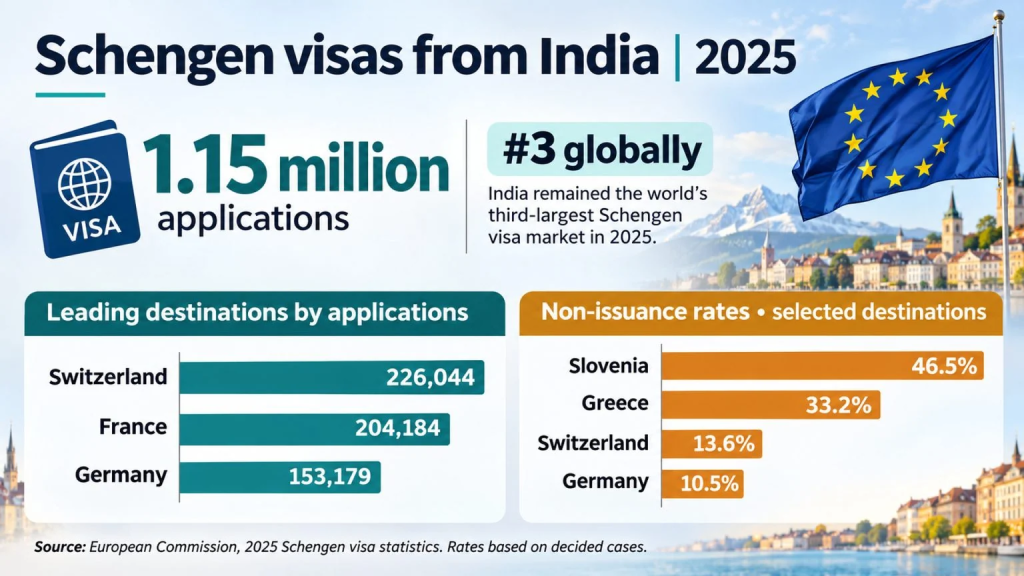
India generated more than 1.15 million Schengen visa applications in 2025, with Switzerland leading demand. Significant differences in visa refusal rates present challenges for European tourism stakeholders.
Applications for Schengen visas from India reached 1,153,748 in 2025, according to the European Commission. India remained the world’s third-largest application market after China and Türkiye. However, substantial differences in visa refusal rates across European destinations highlighted continuing challenges for tourism operators and travellers.
- Schengen visa applications lodged in India increased by 4.1% in 2025, reaching more than 1.15 million.
- Switzerland attracted the most applications, ahead of France and Germany, while Slovenia recorded the highest proportion of non-issued visas.
- Greece registered a non-issuance rate of 33.2%, presenting a significant consideration for tourism businesses targeting Indian outbound travel.
India strengthens its position as a major European travel market
India’s importance to European tourism continued to grow in 2025. Applications increased from 1,108,239 in 2024 to 1,153,748, representing annual growth of approximately 4.1%.
Furthermore, Schengen consulates in India issued 966,529 uniform short-stay visas during the year. Another 181,111 applications resulted in no visa being issued, equivalent to approximately 15.8% of decisions recorded.
The data reinforces India’s position as an important source market for European destinations. However, application volumes should not be interpreted as actual visitor arrivals, as visa issuance does not necessarily translate into completed travel.
Switzerland leads Schengen visa demand from India
Switzerland recorded the highest application volume among Schengen destinations, receiving 226,044 requests in India during 2025. The country issued 195,369 uniform visas and registered a non-issuance rate of approximately 13.6%.
France followed with 204,184 applications, while Germany ranked third with 153,179. Together, these three countries accounted for approximately 50.6% of all Schengen visa applications submitted in India.
Meanwhile, the Netherlands received 97,650 applications, followed by Spain with 90,720. Italy recorded 53,423 applications, Austria 48,761 and Greece 41,009.
The figures demonstrate the concentration of demand among established European destinations. Nevertheless, differences in consular outcomes underline the operational complexity facing travel businesses serving the Indian market.
Slovenia and Greece record elevated visa non-issuance rates
Despite the growth in Schengen visas from India, visa outcomes differed considerably between destination countries.
Slovenia recorded the highest non-issuance rate among Schengen countries processing applications in India, at approximately 46.5% of decided cases. However, its relatively small application volume of 3,910 warrants caution when comparing outcomes with larger markets.
Bulgaria registered a non-issuance rate of 37.9%, followed by Lithuania at 35.7%. Malta recorded 32.1%, while Slovakia’s rate stood at approximately 23.5% when calculated against decided cases.
Greece represented a particularly significant case because of its larger application volume. Greek consular services received 41,009 applications in India and issued 27,232 uniform visas. Meanwhile, 13,526 cases resulted in no visa being issued, corresponding to a non-issuance rate of approximately 33.2%.
Discover more
Travel guides Asia
Sustainable tourism consulting
Asia-Pacific market insights
In contrast, Denmark recorded a rate of approximately 7.1%, Belgium 7.8% and Germany 10.5%. Switzerland’s rate was also below the overall level recorded in India.
These comparisons require careful interpretation. In particular, smaller application pools can produce substantial year-on-year fluctuations, while differences in application profiles may influence national outcomes.
What the visa figures mean for European tourism businesses
The latest figures carry several implications for destination management organisations, tour operators, hotels and travel intermediaries targeting Indian outbound demand.
Firstly, the scale of applications confirms the commercial importance of maintaining effective distribution and marketing channels in India. European destinations can use this demand to support leisure, luxury, group and business travel development.
However, visa-related uncertainty can complicate booking conversion, particularly for products requiring substantial advance commitments. Higher non-issuance rates may create additional risks for accommodation bookings, organised tours and event participation.
Consequently, travel businesses may benefit from more flexible booking conditions, clearer documentation guidance and better coordination with authorised visa application providers. Such measures cannot influence consular decisions, but they can help operators manage cancellations and customer expectations.
For Greek tourism stakeholders, the combination of 41,009 applications and a comparatively high non-issuance rate deserves particular attention. It highlights the importance of monitoring visa accessibility alongside air connectivity, destination promotion and distribution performance.
Another relevant indicator concerns multiple-entry visas. Approximately 57.6% of uniform Schengen visas issued in India during 2025 allowed multiple entries. This creates opportunities for repeat visits, although the statistics do not establish how many visa holders subsequently travelled more than once.
Visa accessibility remains a strategic consideration
As European destinations compete for Indian outbound demand, efficient travel planning and realistic visa timelines remain important commercial considerations.
Under European Commission rules, travellers must apply through the country representing their main destination. Therefore, historical refusal rates do not provide a legitimate basis for selecting an unrelated country for visa applications.
Furthermore, the Commission’s statistics measure applications lodged at consulates in India rather than exclusively applications by Indian nationals. The category of visas not issued can also include discontinued examinations, so it should not automatically be equated with formal refusals.
Overall, the 2025 figures demonstrate the sustained importance of Schengen visas from India to European tourism. Switzerland’s leading application volume and the differences in consular outcomes underline the need for destination stakeholders to consider visa administration when assessing market development opportunities.