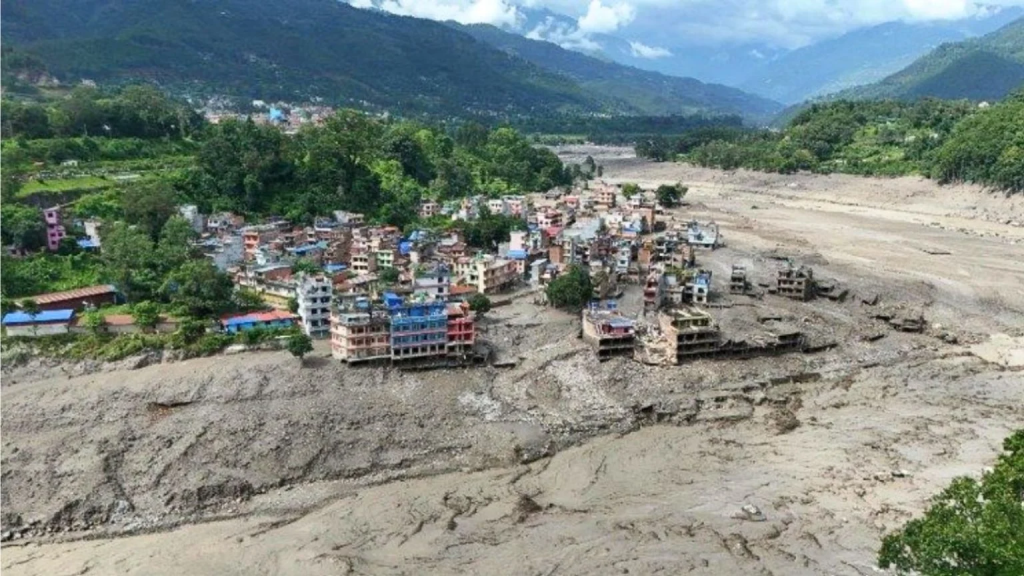
Nepal-Tibet floods have caused widespread damage in Himalayan tourism areas, with hundreds of travellers missing and rescue teams continuing operations.
Nepal-Tibet floods have severely affected Himalayan tourism routes, with hundreds of travellers reported missing and rescue operations continuing across affected areas.
At least 165 people have lost their lives following major floods near the Nepal-China border. The disaster has damaged important trekking and pilgrimage tourism corridors in Nepal and Tibet.
Tourism areas affected by floods
The disaster began on Wednesday, 26 August 2026, when a large mass of ice, rocks and debris collapsed in a mountain area near the Nepal-China border.
The collapse entered the Lhende Khola river system and created a powerful flow of water, mud and debris. The flooding moved through valleys in Tibet and Nepal, affecting communities along the Bhote Koshi and Trishuli rivers.
Initial reports suggested that an earthquake may have caused the event. However, later seismic analysis indicated that the recorded activity came from the collapse itself rather than an earthquake.
Satellite analysis showed that part of a glacier collapsed from an altitude of around 5,200 metres and fell approximately 1,200 metres into the valley. The collapse carried rocks and sediments into lower areas.
Hundreds of tourists reported missing
Nepalese authorities reported that 579 tourists were missing, including more than 400 foreign nationals. Earlier figures from the Nepal Tourism Board had listed 403 missing travellers, including 341 foreign visitors and 62 Nepali citizens.
BookVacation Rentals
Authorities and tourism organisations continue to contact trekking groups and pilgrimage travellers who were in the affected areas.
Reported missing foreign nationals include:
- India: More than 130 Indian citizens have been reported missing, according to India’s Ministry of External Affairs.
- Australia: Thirty-four Australians are missing, with authorities working with Nepalese officials to locate them.
- United States: At least 47 US citizens have been reported missing, according to reports citing Nepal Tourism Board officials.
- United Kingdom: Thirty-three British citizens are reported missing.
- Canada: Twenty-four Canadian citizens are missing, according to Nepalese diplomatic sources.
- Malaysia: Malaysian authorities lost contact with at least 11 citizens in the affected area.
- South Korea: Nine South Koreans working at a hydropower facility are missing, while another 10 remain stranded.
- Japan: Japan’s embassy in Nepal has been unable to contact five Japanese nationals.
Travellers from South Africa, Singapore and several European countries are also among those reported missing.
Damage to key Himalayan travel corridors
Many affected visitors were travelling through Rasuwa district towards the Kailash Mansarovar region in Tibet. Around 400 pilgrims were preparing to cross the Nepal-China border when the floods occurred.
The Nepal Tourism Board had also identified travellers heading towards Gosainkunda through trekking and travel companies operating in the region.
Rasuwa is an important tourism corridor in northern Nepal. Syabrubesi serves as a major gateway to the Langtang trekking region, while the Rasuwagadhi-Gyirong border crossing connects Nepal and Tibet for pilgrims and international visitors.
The floods damaged areas including Timure, Rasuwagadhi and Syabrubesi. Hotels, buildings, roads, bridges, customs facilities, power networks, and telecommunications infrastructure were damaged.
CompareHotel Deals
Government officials said 19 road bridges and around 40 kilometres of roads were damaged. More than 300 vehicles and trucks near the border checkpoint were also reportedly swept away.
Large-scale rescue operations underway
Damage to roads and communication networks has complicated efforts by tourism authorities, travel companies and diplomatic missions to locate visitors.
Tourism officials, security agencies and local authorities are working to verify passenger lists and contact trekking groups in affected areas.
Search and rescue operations continue with helicopters and ground teams. More than 5,000 emergency personnel are involved in response activities across Nepal and Tibet.
Helicopters are being used to reach isolated areas and deliver food, temporary shelter materials and emergency supplies.
The Nepalese government has mobilised military and civilian helicopters. Authorities are also working to restore roads, electricity, drinking water supplies and telecommunications.
Travel advisories updated after disaster
Authorities have declared the affected areas disaster response zones for three months. The Nepalese government has also approved free medical treatment for injured people.
The floods struck the same northern Nepal border region that experienced major flooding in July 2025. That disaster damaged roads, hydropower facilities and the bridge connecting Nepal and China.
Following the latest event, several governments are coordinating with Nepalese authorities regarding missing citizens. United Nations agencies are also mobilising assistance, while India, China and other countries have offered emergency support.
Authorities in several countries have begun updating travel advisories for Nepal as the scale of the damage becomes clearer.