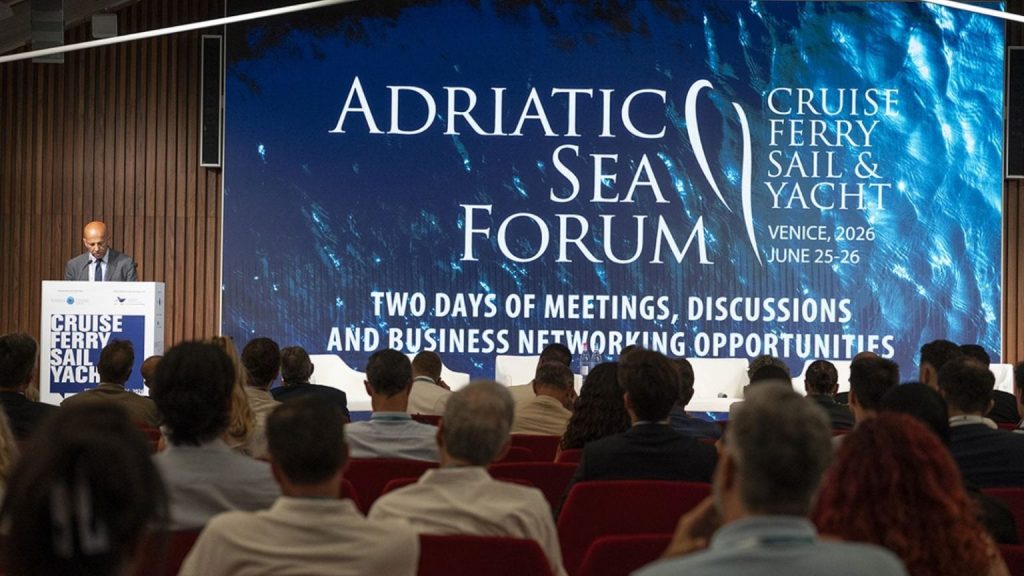
Adriatic maritime tourism is forecast to grow again in 2026, supported by stronger cruise and ferry traffic, expanding marina capacity and more than €843 million in planned infrastructure investments.
Adriatic maritime tourism is expected to continue its upward trajectory in 2026, with stronger cruise and ferry traffic, expanding marina capacity and more than €843 million in planned infrastructure investments. The findings come from the latest Adriatic Sea Tourism Report, presented during the opening of the eighth Adriatic Sea Forum – Cruise, Ferry, Sail & Yacht in Venice.
Produced annually by Risposte Turismo, the report analyses maritime tourism across the seven Adriatic countries, covering cruise operations, ferry services, nautical tourism and future investment plans. The research highlights continued growth across all three sectors and identifies opportunities to strengthen the region’s competitiveness in the Mediterranean.
Cruise sector moves closer to pre-pandemic levels
The report forecasts approximately 5.7 million cruise passenger movements across the Adriatic’s 35 cruise ports during 2026, representing a 6% increase compared with 2025. Cruise calls are also expected to rise by 7.7% to around 4,000, the highest number ever recorded in the region.
Although the sector continues to recover, cruise passenger volumes remain below the record achieved in 2019. According to Risposte Turismo, the Adriatic is the only Mediterranean macro-region that has not yet fully regained pre-pandemic cruise traffic, largely due to infrastructure limitations and regulations that restrict access for larger cruise ships.
Italy will remain the leading Adriatic cruise market with more than 2.1 million passenger movements, representing 37.3% of the regional total, followed by Croatia with 1.61 million passengers. Greece is expected to surpass one million cruise passenger movements for the first time.
Corfu will retain its position as the Adriatic’s busiest cruise port for the seventh consecutive year, exceeding one million passenger movements. Dubrovnik is forecast to welcome approximately 675,000 passengers, followed by Kotor with 615,000. Bari and Venice complete the top five ports, although Venice is expected to record a 9.3% decline compared with 2025.
The fastest-growing cruise ports this year are expected to be Bar, with passenger traffic increasing by 78.5%, and Ravenna, where passenger movements are forecast to grow by 57.2%.

Ferry traffic and marina capacity continue expanding
The ferry, hydrofoil and catamaran sector is also expected to perform strongly, with passenger movements forecast to reach 20.6 million in 2026, representing .
Split will remain the Adriatic’s largest ferry port with more than 5.2 million passenger movements, followed by Igoumenitsa with over 3.1 million and Zadar with approximately 2.7 million.
The report also highlights continued expansion in nautical tourism. Researchers identified 347 marinas and tourist ports operating across the Adriatic, with almost 93% located in Italy and Croatia. Total berth capacity has increased to 81,710 berths, up 1.3% compared with 2024. Italy accounts for 49,597 berths, while Croatia offers 21,847.
Risposte Turismo also reports improving conditions in the yacht charter market. Both sailing and motor yacht charter operators expect stronger business than in recent years, supported mainly by growing domestic demand.
More than €843 million planned for maritime tourism infrastructure
The report identifies more than €843 million in planned investments for maritime tourism infrastructure between 2027 and 2030. More than €573 million will support cruise and ferry facilities, while €270 million has been allocated to nautical tourism infrastructure, including the construction of seven new marinas.
Major projects include cruise infrastructure upgrades in Venice, Trieste, Monfalcone, Ancona, Bari, Brindisi and Termoli. Croatia will invest in new passenger terminals in Pula, Split and Korčula, while Dubrovnik continues work on the Batahovina II development. Albania is progressing with new luxury marinas in Vlora and Durrës, while Greece plans further investment in Igoumenitsa and the new Lamda Corfu Marina.
Francesco di Cesare, President of Risposte Turismo, said the Adriatic maritime sector remains healthy thanks to continued public and private investment and resilient tourism demand. However, he noted that future growth will depend on stronger cooperation between coastal destinations and inland regions, better accessibility and coordinated tourism planning across the Adriatic.
Matteo Gasparato, President of the Northern Adriatic Sea Port Authority, said sustainable infrastructure, balanced destination management and stronger cooperation across the region will be essential for the future of maritime tourism.
Simonida Kordić, Minister for Tourism of Montenegro, highlighted the Adriatic’s potential to position itself as a unified macro-destination offering sustainable, authentic and year-round tourism experiences.
Alessandra Priante, President of ENIT, added that the Adriatic’s future competitiveness will depend on coordinated governance, data-driven planning and transforming the region’s diversity into a coherent tourism offering.