Nepal tourism recovery remains uncertain as political change, infrastructure gaps, and aviation challenges persist, despite strong fundamentals, new investments, and renewed industry expectations following the 2026 government transition.
Nepal belongs to the destinations many people dream about to visit, but few ever do. In the Brand Quartet approach, the country easily clears the first two hurdles: Yes, potential visitors have heard about the destination, and Yes, most potential visitors have a positive image of the place as a tourist destination. However, when it comes to the third and fourth step: Have you been there? and Do you plan to visit soon? The percentage of positive answers drops to single-digit numbers.
Political context and recent developments

Nepal is located in a geopolitically important location, sandwiched between the two most populous countries in the world and bordering the sensitive region of Tibet. Nevertheless, it seldom makes it into global headlines. The last two incidents were a devastating earthquake in Kathmandu in 2015 and the GenZ uprising in September 2025, which saw 77 demonstrators dead and many buildings, including the parliament and the Hilton Hotel, go up in flames.
The material damage from the earthquake has been repaired; however, the September uprising led to the fall of the government, elections, and, on the 27th of March, 2026, the installation of a new government. After almost 20 years of rule by the former guerrillas who ousted the monarchy, which was characterised by rampant corruption and stalled development, Nepal remained the third-poorest country outside of Africa and saw more than 2,000 of its citizens leaving the country daily (!) in search of better jobs in India, Dubai or Europe.
New leadership and expectations

Unsurprisingly, the opposition won almost 2/3 of the seats in the March 5th elections. The new leader is Balen Shah, a 36-year-old former rapper and mayor of Kathmandu City, who never takes off his black sunglasses and presides over a parliament with many more younger and female members than before.
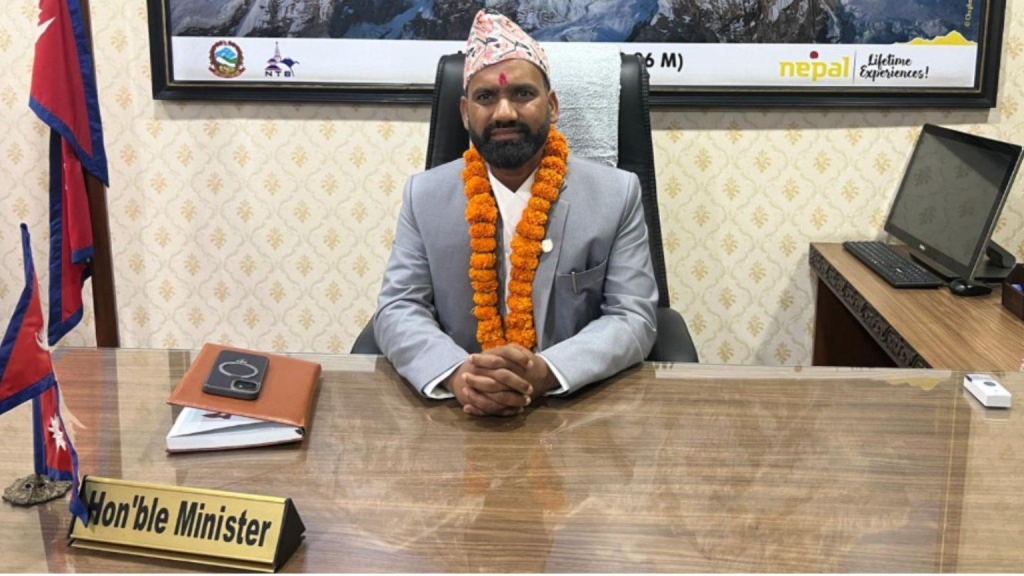
Expectations are high, even though the attack on Iran and the following ongoing conflict will add additional problems to solve on top of the many existing ones. Inflation and insecure gas and petrol supplies are compounded by lower remittance levels from the almost two million Nepalis working in the Middle East. One of the 14 newly appointed ministers is the novelist, journalist and English Literature teacher Khadkaraj Paudel, known by his literary name Ganesh Paudel, who has taken over the Ministry of Culture, Tourism and Aviation. His only experience with tourism is based on the fact that he grew up and lives in Pokhara, the second largest city in the country and the “tourism capital” of Nepal.

Tourism demand under pressure
Times are bad for tourism in Nepal this spring, with more than 50% of bookings cancelled due to the fighting in the Middle East and the disruption of aviation routes, especially from Europe, right at the beginning of the main season. Nevertheless, the tourism industry is optimistic that two decades of non-development are over in this important part of Nepal’s economy as well.
Strong fundamentals but weak performance

Pride Nepal Travel and Tours
As of now, Nepal’s tourism is lagging behind international development by decades despite very favourable conditions: half of mankind lives within five hours’ flight, Nepal enjoys good air connectivity, and it has abundant natural, cultural, and heritage resources. The country is home to a hospitable English-speaking population and offers a high level of safety, affordable prices, a moderate climate, and unique lighthouse icons, including Lumbini, Buddha’s birthplace, and eight of the ten highest mountains in the world, including the number one peak, Mount Everest.
Given such favourable odds, it is not easy to avoid being a successful tourism destination. However, Nepal managed to stay at a hilariously low level of around one million international arrivals, who spend less than 50 USD per person per day.
Infrastructure and transport challenges
There are many reasons for that: Road transport is slow and hazardous, even for the 200 km drive from Kathmandu to Pokhara, six to eight hours are needed, depending on the weather conditions.
Domestic air transport is badly organised, with many flights that take less than an hour delayed by half a day. More than a decade ago, the European Union banned Nepali airlines from its skies due to Nepal’s low aviation safety standards. In the last four years, more than 100 passengers have died in several air transport accidents. Passengers without a Nepali passport not only have to pay double the price for domestic flights, but also have to pay in US dollars, not Nepali rupees.
Aviation governance and airport limitations

The national carrier Nepal Airlines (formerly Nepal Royal Airlines) Corporation carries a debt of around 350 million USD. New international airports were opened in Pokhara and Bhairahawa near Lumbini in recent years; however, no international airlines have launched routes from them due to poor construction resulting from corruption and disagreements with neighbouring India over the use of Indian airspace. Meanwhile, Tribhuvan International Airport in Kathmandu looks like a 1980s airport frozen in time, still waiting for the implementation of a master plan for development approved almost ten years ago. The fact that the Civil Aviation Authority of Nepal currently serves as both regulator and service provider has not, to say the least, helped provide good governance, transparency, and efficiency.
Hospitality landscape and market imbalance

The number of international hotels in Kathmandu has increased in the last few years, with brands like Dusit, Marriott, Mercure, Ramada, Radisson all present. The Hilton Hotel burnt down and the Hyatt-Regency was seriously damaged in September last year and is still closed. There are also a number of non-branded high-quality hotels available, built in traditional Newari red-brick style like the Dwarika, the Traditional Comfort and the Yak & Yeti. As the number of international arrivals is however still hovering around the one million mark, most hotels had to lower their rates dramatically in an ongoing cut-throat competition. The fact that a potential high-end market like the GCC countries amounted to no more than 2,000 arrivals from Dubai, Abu Dhabi, Qatar, Saudi Arabia etc. combined in 2025, illustrates the many unused opportunities. On websites like HalalBooking.com, the number of hotels in Nepal which are considered acceptable for Halal tourism is Zero.
Fragmented tourism supply and limited innovation
There is not a single major tour operator in Nepal. As a result, the myriads of micro and small enterprises face severe difficulties innovating and are all offering basically the same old-fashioned sightseeing round-trips, again competing mostly on price and consequently attracting, for instance, only the bottom end of source markets from China. Hiking, trekking and mountaineering are the only other activities with a wider variety of offers. Sustainable tourism offers exist, but are hard to find. Nepal could be a major destination for the growing number of travellers seeking transformative experiences, spirituality, local communities still largely untouched by modern society, or for tourists having a passion for food, art, music, architecture and so on.
Marketing gaps and digital underdevelopment

Among the reasons for the underperformance of the tourism sector in Nepal, marketing is considered one of the most important ones. International tourism marketing is almost non-existent, and the marketing that does exist often fails to align with the interests of potential source markets. The use of Social Media is underdeveloped, with many hotels, restaurants, and tour operators offering only Facebook pages.
Investment, partnerships and development funding
Thanks to its important geopolitical location, Nepal is not short of partners providing development aid. The UNDP recently provided the Nepal Tourism Board with 1.5 million USD to support sustainable tourism development. The World Bank even announced that a total of 85 million USD will be made available to develop the tourism infrastructure in Lumbini. The resources are known, the solutions are obvious, many Best Practice Examples are available worldwide, and financing is possible. The main problems are the lack of an overarching, holistic strategy, a lack of a clear vision, and, consequently, a lack of SMART KPIs to measure the success of defined, transparent steps towards development.
Emerging initiatives and innovation pipeline
The results of the March 5th, 2026, elections have revitalised the industry. A local Start-Up is working on a much-needed online portal that, with the help of AI, connects special-interest demand with available products and services. There are initiatives to develop Lumbini, the birthplace of Buddha, into a Davos-style meeting point for an annual global Peace and Wellbeing conference. The Meaningful Tourism Centre, which has its headquarters in Kathmandu, is in the process of opening, with partners, a Meaningful Tourism Innovation Lab and starting, with the support of TravelDailyNews Asia-Pacific, a series of weekly podcasts on tourism development across South Asia, with the technical realisation organised in Nepal.
Strategic direction for the future
PATA Pacific-Asia Travel Association, the major international tourism organisation for the continent, last year adopted a Vision statement for the Asia Pacific region, the establishment of a Meaningful Pacific-Asia Tourism Economy. This should also be the guiding light and compass for a successful and sustainable development of tourism in Nepal.
Tourism as a socio-economic lever
Tourism can become a major tool for the new government to stop the flow of citizens from the villages to Kathmandu seeking a better life and from the country to overseas destinations for work and education. Providing value and income to rural areas and creating qualified jobs in the city can help give the many young, bright Nepalis, who, through their protests, pushed the reset button for the country, the opportunity to stay in their communities and present the world with another enjoyable, Meaningful Tourism destination.
Leadership narrative and positioning
The new minister, Paudel, is reported to follow the motto “Win by ideas, endure through character”. Not bad for a way to describe how destinations can attract visitors and provide benefits and satisfaction to all stakeholders in tourism.