While infrastructure may be at the heart of the decision, experts wonder if a structural imbalance may be involved
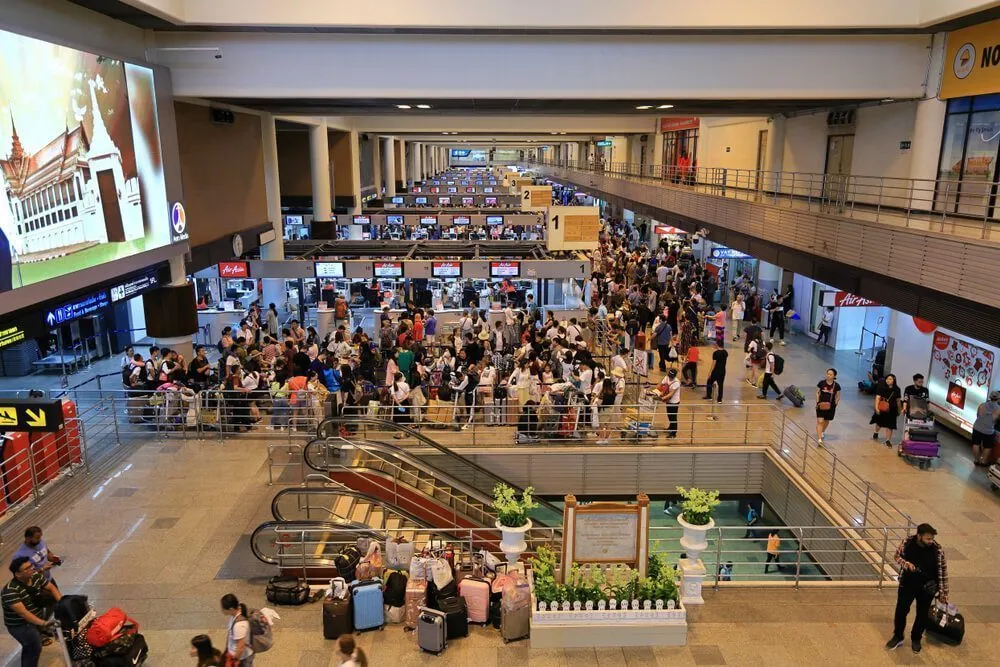
On Friday, 20th February, Airports of Thailand announced that they would increase the current outbound passenger service charge (PSC) for international flights by nearly 50 percent.
From 20th June 2026, those flying overseas from Suvarnabhumi, Don Mueang, Phuket, Hat Yai, Chiang Mai, and Chiang Rai will need to pay 1,120 baht (slightly over US$36) instead of the 730 baht (US$23.51) currently tacked onto their flight fares.
But, as with all taxes and fees charged to the general public, this announcement has faced significant backlash as both officials and travellers ponder if higher fees will mean improved services and facilities at AOT airports.
For now, the response given by AOT states that additional revenues will go into a number of airport expansion projects, including the new terminal being built at Bangkok’s Suvarnabhumi Airport.
Interestingly, this decision was approved last 3rd December 2025 but only made public last week.
As a result, members of the public have been calling out the impending implementation, resulting in a number of comments on social media.
One commenter went so far as to say:
“This is a mistake. Where do they think money is coming from? I think immigration is the only thing they can control and make a spectacle of, but what do they think the Thai economy is based on?”
Why and why now?
Those who have voiced significant opposition against the increase pointed out one crucial development that supporters seem to have forgotten: Thailand has seen a 7.53 percent decrease in foreign arrivals in the first half of Q1-2026, and arrival numbers as of 14th February are down 7.2 percent from where they were at the same time last year.
This prompted sharp criticism from Samart Ratchapolsitte, former deputy leader of the Thai Democratic Party, who decried how the increase will make AOT airports more expensive than their counterparts overseas.
Those supporting the increase have reiterated that the raison d’etre behind it is improved infrastructure for the country’s primary aviation hubs; after all, any major infrastructure expansion initiative requires a staggering amount of capital.
Going by the User Pays principle, supporters argue that those who benefit from airports ought to help finance their development and / or refurbishment.
Is it necessary at this point?
Going by Thai lawyer and columnist Victor Wong’s recent piece for Pattaya Mail, airport revenues are divided into two main categories: aeronautical revenue and non-aeronautical revenue.
The former is made up of passenger charges, landing or departure fees, as well as service fees charged by individual airlines.
The latter, on the other hand, is taken from retail concessions at airports, duty-free shops, out-of-home on-site advertising spaces, hospitality, and logistics.
In recent years, many of the world’s leading airports are shifting their dependence from aeronautical to non-aeronautical revenue as the latter generates greater profits without encumbering travellers with additional fees or taxes.
As Wong puts it: “The stronger the commercial ecosystem inside and around an airport, the less pressure there is to raise passenger fees. The PSC increase therefore invites a policy question: Has Thailand sufficiently diversified its airport income streams, or does passenger charging remain the primary lever for funding large scale expansion?”
Wong further opined that, if Thailand is still relying on passenger charges to fund relevant initiatives, then AOT’s revenue model is structurally imbalanced and will be a cause of greater stress on travellers moving forward.
Interestingly, Thailand isn’t the only country coming under flak for its departure taxes; it will be recalled that the Philippine airport system was called out numerous times for the nearly US$30 travel tax charged per traveller, ostensibly to fund airport maintenance.
That tax has been hit by critics numerous times, especially given how maintenance at Philippine airports has been seen as more cosmetic than functional, but the protests have led to the filing of a bill abolishing the said tax on Monday, 23rd February.
Wait and see
But going back to Thailand, the matter isn’t so much an argument over the increased amount as it is about whether or not such charges are necessary.
As experts put it, it’s also a question as to whether or not the country’s airport revenue framework is both sustainable and properly diversified.
Especially given recent developments regarding tourist arrival numbers, perhaps this decision needs to be put on the back-burner and given more thought prior to implementation.
After all, as with everything in this world and especially where public policy is involved, it is always better to be safe than sorry.